
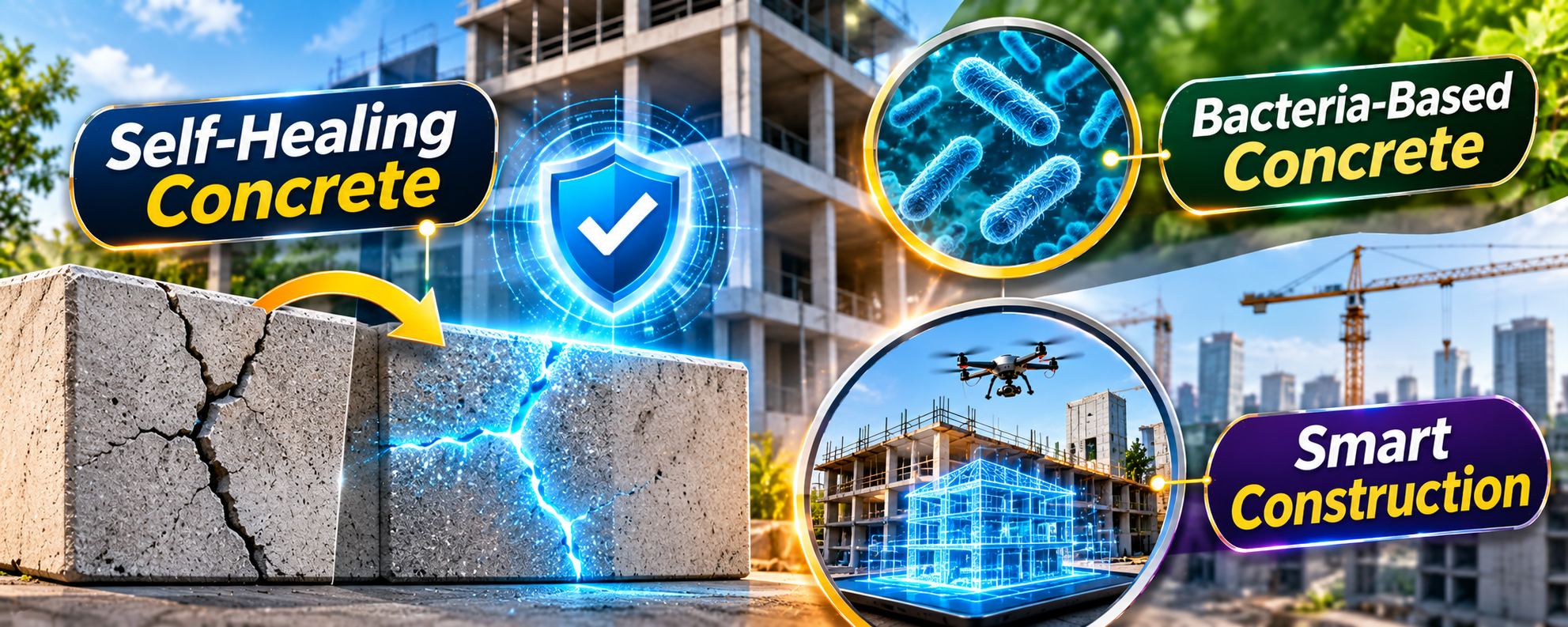

Concrete is one of the most widely used construction materials in the world. From residential buildings and commercial complexes to bridges, roads, dams, and industrial structures, it plays an essential role in modern infrastructure. However, even properly designed concrete structures can develop cracks over time due to shrinkage, temperature variations, structural loading, water penetration, and environmental exposure.
Small cracks may initially appear harmless, but if they remain untreated, water and harmful substances can enter the concrete. This can cause reinforcement corrosion, concrete deterioration, leakage, and expensive repair work.
Traditional concrete maintenance generally involves identifying cracks and repairing them using cement-based materials, epoxy injections, sealants, or other specialised products. But what if concrete could repair certain cracks on its own?
This is the idea behind Smart Concrete Technology, an emerging area of construction innovation that includes self-healing concrete.
Self-healing concrete is designed to repair selected cracks automatically through biological, chemical, or other material-based mechanisms. Instead of depending entirely on manual repair, the concrete contains specially developed components that can activate when cracks form and suitable conditions are available.
This technology has the potential to improve the durability of buildings, reduce maintenance requirements, and extend the service life of infrastructure.
In this article, we will explore how smart concrete technology works, different types of self-healing concrete, its applications, advantages, limitations, and future possibilities in the Indian construction industry.
1. What Is Smart Concrete Technology?
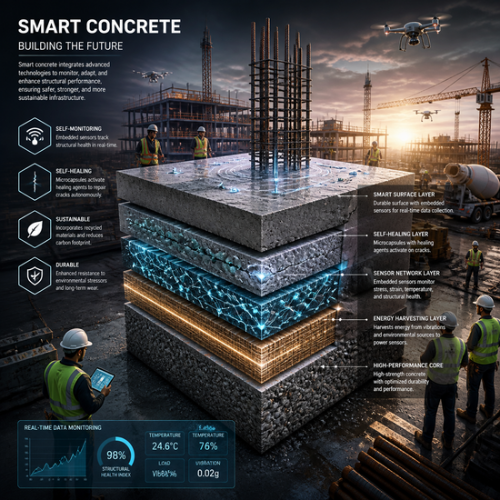
Smart concrete technology refers to the development of advanced concrete materials that can respond to environmental conditions, detect changes, or improve their performance through specially designed ingredients and systems.
Unlike conventional concrete, which generally requires external inspection and repair when cracks develop, smart concrete may include additional properties that help monitor damage or repair certain defects.
Some important smart concrete technologies include:
Self-healing concrete.
Bacteria-based concrete.
Microcapsule-based concrete.
Shape-memory concrete systems.
Conductive concrete for sensing applications.
Concrete with embedded sensors for structural health monitoring.
Among these developments, self-healing concrete has received significant attention because it offers a potential solution to one of the most common problems in concrete construction: crack formation.
However, smart concrete is a broad category. Not every smart concrete material is self-healing, and not every self-healing system can repair all types of structural damage.
2. What Is Self-Healing Concrete?
Self-healing concrete is an advanced concrete material designed to repair certain cracks automatically without requiring conventional manual repair.
It contains special ingredients or healing agents that become active when cracks develop and suitable environmental conditions are present.
The healing process may involve producing calcium carbonate, forming additional cementitious products, or releasing a repair material that fills small cracks.
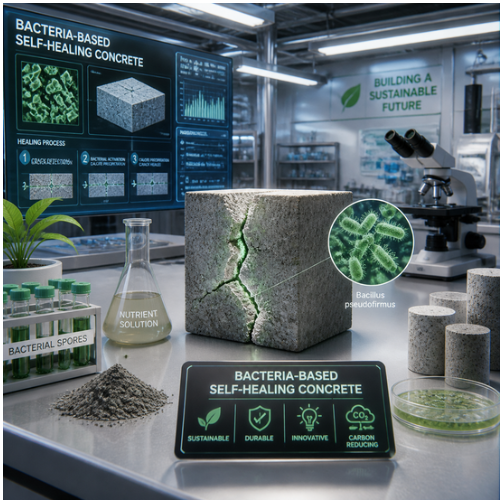
For example, in bacteria-based self-healing concrete, specially selected bacteria remain inactive inside the concrete until water and other required conditions reach them through a crack.
Once activated, the bacteria can contribute to the formation of calcium carbonate, which gradually fills certain cracks.
The main objective is to reduce water penetration, improve durability, and limit further deterioration.
Important distinction: Self-healing concrete is generally intended for small cracks and selected forms of damage. It cannot automatically restore a severely damaged beam, replace missing concrete, or repair a structurally unsafe building.
3. How Does Self-Healing Concrete Work?
The working process depends on the type of self-healing technology used.
However, the general concept is similar: a crack develops, a healing mechanism becomes active, and a material is produced or released to seal the damaged area.
Let’s understand the process through a simple example.
Step 1: Concrete preparation
Special healing agents are incorporated into the concrete mixture during manufacturing. These may include bacteria, nutrients, mineral additives, or microcapsules containing repair materials.
Step 2: Crack formation
Over time, small cracks may develop due to shrinkage, temperature changes, loading, or other environmental conditions.
Step 3: Activation of the healing mechanism
Water and other environmental conditions may activate the healing agents or cause microcapsules to rupture.
Step 4: Crack filling
The activated system produces calcium carbonate, additional cementitious compounds, or another sealing material that fills the available crack space.
Step 5: Improved resistance to water penetration
When the healing process is successful, the crack may become partially or substantially sealed, reducing the movement of water and certain harmful substances.
4. Different Types of Self-Healing Concrete
There are several approaches to developing self-healing concrete. Each uses a different mechanism to repair cracks.
A. Bacteria-Based Self-Healing Concrete
Bacteria-based self-healing concrete uses specially selected microorganisms that can contribute to calcium carbonate formation.
The bacteria and suitable nutrients are incorporated into the concrete, often using protective carriers or capsules.
When cracks allow water to enter, suitable bacteria may become active and initiate biological processes that result in calcium carbonate precipitation.
This mineral deposit can fill small cracks and reduce water penetration.
Applications:
Residential concrete walls.
Water-retaining structures.
Underground concrete structures.
Bridges and infrastructure exposed to moisture.
B. Microcapsule-Based Self-Healing Concrete
This technology uses tiny capsules containing specialised healing agents.
When a crack passes through a capsule, the capsule may break and release its contents into the crack.
The released material reacts, hardens, or bonds with the surrounding concrete to seal the damaged area.
Possible healing agents include polymer-based materials, adhesives, and other chemical compounds.
Applications:
Concrete floors.
Precast concrete components.
Selected structural and non-structural concrete products.
Specialised infrastructure projects.
C. Autogenous Self-Healing Concrete
Autogenous healing is the natural ability of concrete to seal certain small cracks without adding special bacteria or capsules.
It can occur through continued hydration of unhydrated cement particles and the precipitation of calcium carbonate when moisture and suitable conditions are available.
For example, when water enters a narrow crack, unhydrated cement particles may continue reacting and form additional hydration products.
This process can help close very small cracks under favourable conditions.
Applications:
Conventional reinforced concrete structures.
Water-retaining structures.
Concrete elements exposed to suitable moisture conditions.
D. Mineral-Based Self-Healing Concrete
Mineral-based systems use selected mineral additives or reactive compounds to support crack sealing.
Depending on the formulation, these materials may promote additional mineral precipitation or reactions that fill cracks and reduce permeability.
Applications:
Water tanks.
Underground structures.
Concrete foundations.
Selected infrastructure components.
E. Shape-Memory-Based Concrete Systems
Some advanced concrete systems use shape-memory materials that respond to changes in temperature or other external conditions.
These materials can recover a programmed shape under suitable activation conditions and may help close certain cracks.
Unlike conventional biological healing systems, this approach relies on the physical behaviour of specialised materials.
Applications:
Specialised structural components.
Research-based infrastructure systems.
Advanced engineering applications.
This technology is still a specialised research area and should not be confused with widely available commercial concrete products.
5. Important Ingredients Used in Smart Concrete Technology
The performance of self-healing concrete depends heavily on the materials used in its formulation. Unlike conventional concrete, which mainly uses cement, aggregates, water, and admixtures, smart concrete may contain additional functional ingredients.
Some important components include:
1. Cement: Cement acts as the primary binding material and provides the basic strength required for concrete construction.
2. Bacterial spores: Specially selected bacteria are used in biological self-healing systems. They are often protected inside carriers so they can survive the harsh alkaline environment of concrete.
3. Nutrients: Certain bacterial systems require nutrients such as calcium-based compounds and other suitable substrates to support mineral precipitation.
4. Microcapsules: These small capsules contain healing agents that are released when cracks damage the capsules.
5. Mineral additives: Selected mineral compounds can support additional hydration reactions or mineral formation.
6. Chemical admixtures: Superplasticisers and other admixtures help control workability, setting time, and concrete performance.
7. Fibres: Steel, polypropylene, or other suitable fibres can help control crack formation and limit crack widths.
The selection and quantity of these ingredients must be based on laboratory testing and the intended application. Simply adding bacteria, fibres, or chemicals to ordinary concrete does not automatically make it effective self-healing concrete.
6. Major Advantages of Self-Healing Concrete
Self-healing concrete offers several potential advantages over conventional concrete, particularly in structures where water penetration and repeated crack repairs are major concerns.
Reduced Crack Repair Requirements
One of its biggest advantages is the ability to seal certain small cracks without conventional manual intervention.
This may reduce the frequency of minor repair activities, especially in difficult-to-access locations.
Improved Water Resistance
Cracks provide pathways for water to enter concrete. When a self-healing mechanism successfully seals these openings, it can reduce water penetration.
This is particularly useful for underground structures, water tanks, and selected external concrete elements.
Better Protection Against Reinforcement Corrosion
Water and harmful substances such as chlorides can contribute to reinforcement corrosion.
By sealing suitable cracks, self-healing concrete may reduce the movement of these substances towards embedded steel reinforcement.
However, it cannot reverse corrosion that has already caused significant reinforcement damage.
Potentially Longer Service Life
Reducing crack-related deterioration may help extend the service life of concrete structures.
This is particularly valuable for infrastructure where repair work is difficult, expensive, or disruptive.
Reduced Maintenance Expenses
If the healing mechanism performs successfully, some minor crack-sealing and maintenance activities may be avoided.
The actual financial savings depend on the initial material cost, healing performance, inspection requirements, and maintenance conditions.
Improved Sustainability Potential
Longer-lasting concrete structures may require fewer repairs and less replacement material over their service life.
This can potentially reduce material consumption and construction-related environmental impacts.
7. Applications of Self-Healing Concrete in Residential Construction
Self-healing concrete has several potential applications in residential buildings, particularly in areas exposed to moisture, temperature changes, and repeated environmental stress.
A. Residential Foundations
Foundations remain in contact with soil and may experience moisture exposure, groundwater variations, and chemical conditions.
Suitable self-healing concrete systems could help seal certain small cracks and reduce water penetration.
However, foundation safety must always depend on proper structural design, soil investigation, and waterproofing.
B. Basement Walls
Basements are particularly vulnerable to groundwater pressure and moisture penetration.
Self-healing concrete may help seal certain fine cracks in basement walls and reduce leakage pathways.
It should be used alongside proper waterproofing membranes, drainage systems, and construction-joint treatments rather than as their replacement.
C. Roof Slabs and Terraces
Roof slabs are exposed to direct sunlight, temperature variations, and rainfall.
These conditions can contribute to cracking and water leakage.
Self-healing concrete may provide additional protection against selected small cracks, but terrace waterproofing and suitable drainage remain essential.
D. Water Tanks
Underground and overhead water tanks need reliable water-retaining construction.
Certain self-healing concrete technologies can help reduce leakage through small cracks, making them a promising option for water-retaining structures.
E. Bathrooms and Wet Areas
Bathrooms, utility areas, and other wet spaces require effective moisture protection.
Self-healing concrete may support durability by sealing certain small cracks, but conventional waterproofing systems and properly detailed plumbing connections are still necessary.
F. External Walls and Balconies
External concrete elements are exposed to rain, heat, and environmental changes.
Selected self-healing systems may help reduce the risk of water entering through small cracks.
8. Applications Beyond Residential Buildings
The potential of smart concrete technology extends far beyond residential construction.
Some of its most promising applications are found in infrastructure projects where durability and maintenance are major concerns.
Application | Potential Benefit |
|---|---|
Bridges | Helps seal selected cracks and reduce moisture penetration |
Dams | Supports crack sealing in suitable water-retaining concrete elements |
Tunnels | May reduce water ingress through certain fine cracks |
Roads | Can improve crack management in selected concrete applications |
Parking structures | Helps protect concrete against moisture and chloride exposure |
Industrial floors | May reduce maintenance requirements in suitable environments |
Water treatment plants | Supports durability of concrete exposed to water |
Underground structures | Helps reduce certain moisture-related deterioration pathways |
For large infrastructure projects, even a small improvement in durability may have significant long-term value because inspection and repair activities can be costly and difficult to perform.
However, these applications require project-specific testing, engineering approval, and quality control.
9. Smart Concrete vs Conventional Concrete: What Is the Difference?
Although both materials use cement-based mixtures, smart concrete and conventional concrete differ in their intended functionality.
Comparison Factor | Conventional Concrete | Smart Concrete |
|---|---|---|
Main purpose | Structural construction | Structural performance with additional functional properties |
Crack management | Usually requires external repair | Some systems can heal selected cracks |
Sensors | Not normally included | May include embedded sensors |
Material composition | Cement, aggregates, water and admixtures | May include bacteria, capsules, fibres or functional additives |
Water resistance | Depends on mix design and protection | Some systems can improve crack sealing |
Maintenance | Regular inspection and repair | May reduce selected repair requirements |
Initial cost | Generally more economical | Often higher for specialised formulations |
Technology | Established construction method | Advanced and developing technology |
Availability | Widely available | Limited and application-dependent |
One important point is that smart concrete is not necessarily stronger than conventional concrete.
Its additional value comes from properties such as self-healing, sensing, or improved crack management. The structural strength must still be established through appropriate testing.
Conclusion
Smart concrete technology represents an important step towards developing more durable and efficient construction materials. Self-healing concrete, in particular, offers an interesting solution to the problem of small cracks that can allow water and harmful substances to enter concrete structures.
Through bacteria-based systems, microcapsules, mineral additives, and natural healing mechanisms, certain concrete formulations can repair selected cracks without conventional manual intervention.
Its potential applications include residential foundations, basements, terraces, water tanks, bridges, tunnels, and other infrastructure projects.
However, self-healing concrete is not a replacement for good construction practices. Proper structural design, reinforcement detailing, concrete quality, curing, waterproofing, and regular inspection remain essential.
For the Indian construction industry, the technology could become increasingly valuable as research improves material performance and reduces production costs.
The future of concrete construction may not simply be about making stronger buildings. It may also involve developing materials that can respond to damage, protect themselves against deterioration, and provide better long-term performance.
Frequently Asked Questions
1. What is smart concrete technology?
Smart concrete technology refers to advanced concrete materials that offer additional functional properties, such as self-healing, damage detection, or structural health monitoring. These materials may contain bacteria, microcapsules, specialised fibres, or embedded sensors.
2. What is self-healing concrete and how does it work?
Self-healing concrete is designed to repair certain small cracks automatically. Depending on the technology, bacteria may produce calcium carbonate, microcapsules may release healing agents, or unhydrated cement particles may continue reacting with water to fill cracks.
3. Is self-healing concrete available in India?
Research and development in self-healing concrete are taking place in India, but its commercial availability remains more limited than conventional concrete. Specialised products and formulations may be available through research organisations and advanced construction material suppliers.
4. Can self-healing concrete repair large structural cracks?
No. Most self-healing systems are designed for relatively small cracks. Large structural cracks, severe damage, reinforcement failure, and structural instability require professional inspection and appropriate engineering repairs.
5. Is self-healing concrete stronger than normal concrete?
Not necessarily. Its main purpose is to provide additional crack-healing functionality and potentially improve durability. Its compressive strength and other structural properties depend on the concrete mixture and must be verified through testing.
6. What bacteria are used in self-healing concrete?
Certain specialised Bacillus species have been studied for bacterial self-healing concrete. These bacteria can contribute to calcium carbonate precipitation under suitable conditions. Their selection, protection, nutrients, and survival within concrete are important for performance.
7. Is self-healing concrete waterproof?
Self-healing concrete is not automatically waterproof. It may seal certain cracks and reduce water penetration, but it does not replace waterproofing membranes, construction-joint treatments, drainage systems, or other necessary moisture-protection measures.
8. How much does self-healing concrete cost in India?
The cost depends on the healing technology, ingredients, production process, and project requirements. Specialised formulations generally involve higher initial material costs than conventional concrete. Project-specific quotations are necessary for an accurate comparison.
9. Where can self-healing concrete be used in residential buildings?
It can be considered for foundations, basement walls, roof slabs, terraces, water tanks, balconies, and selected external concrete elements. Its suitability depends on the structural requirements, exposure conditions, and tested performance of the material.
10. Will self-healing concrete replace conventional concrete in the future?
It is unlikely to replace conventional concrete completely in the near future. Instead, it may become a specialised construction material for projects where durability, crack management, and reduced maintenance are particularly important.