
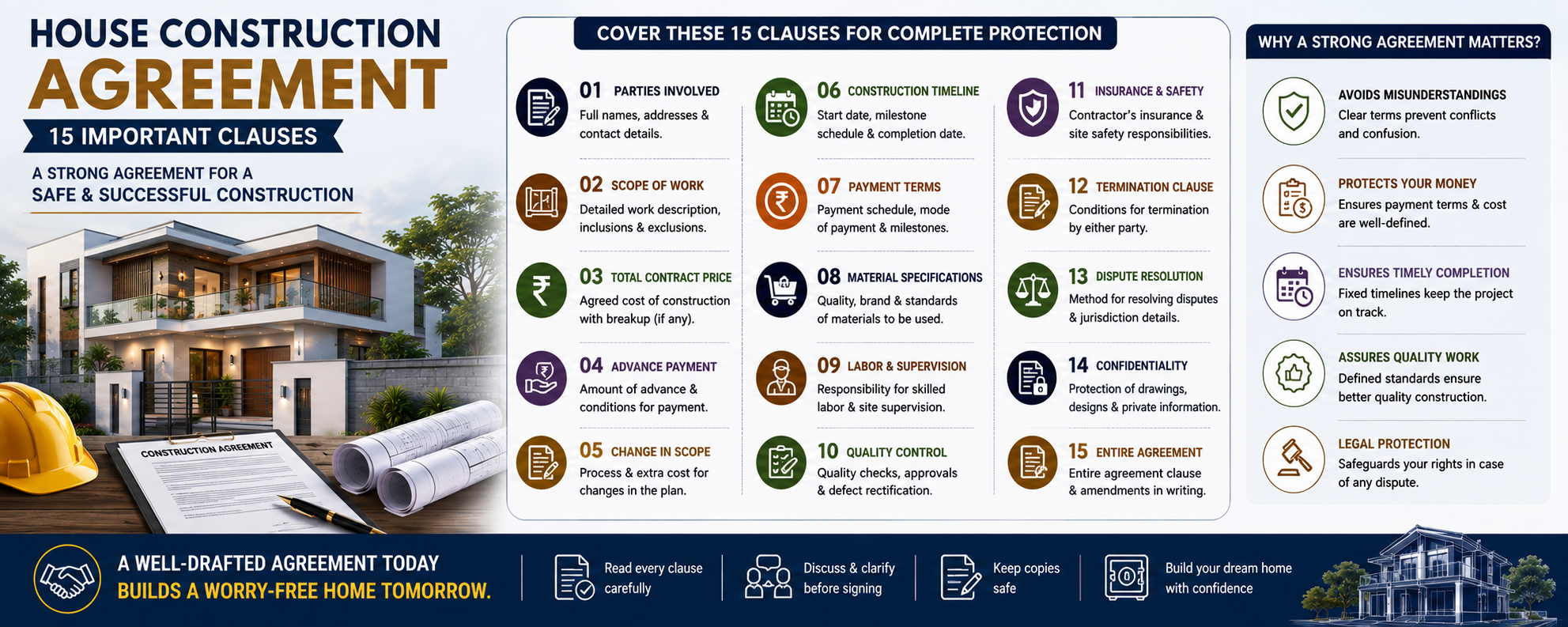

House Construction Agreement: 15 Important Clauses
Building your dream home is one of the biggest financial investments you will ever make. Whether you are constructing a modern villa, an independent house, or a duplex, every successful project begins with a well-drafted House Construction Agreement. Many homeowners focus only on design, materials, and budget but ignore the legal agreement that protects their investment. This often leads to disputes, delays, hidden costs, and poor-quality work.
At Kanakdhara Developer Private Limited, we believe that every homeowner should understand the importance of a professionally prepared construction agreement before signing any contract. A properly written agreement not only protects both the homeowner and contractor but also creates transparency throughout the construction journey.
In this guide, we explain the 15 most important clauses every house construction agreement should include so you can build your dream home with confidence.
Why a House Construction Agreement is Essential
A construction agreement is a legal document that clearly defines the responsibilities, expectations, payment terms, timelines, and quality standards between the property owner and the contractor. Instead of relying on verbal promises, everything is documented in writing, reducing misunderstandings and protecting both parties if disputes arise.
A professionally drafted agreement saves money, minimizes risks, and ensures that your project stays on schedule.
1. Complete Details of Both Parties
The agreement should clearly mention the full legal names, addresses, contact numbers, and identification details of the homeowner and contractor. This establishes the legal identity of both parties and avoids future confusion.
2. Detailed Scope of Work
One of the most important sections is the scope of work. It should clearly define what the contractor will construct, including excavation, foundation, RCC work, brickwork, plastering, flooring, electrical work, plumbing, painting, waterproofing, and finishing.
A detailed scope eliminates assumptions and ensures everyone understands their responsibilities.
3. Approved Drawings and Design Documents
The agreement should reference all approved architectural drawings, structural drawings, electrical layouts, plumbing plans, and elevation designs.
Any future modifications should only be accepted through written approval from the homeowner.
4. Project Timeline
Every construction agreement must specify the project start date and expected completion date.
The agreement should also include milestone deadlines such as foundation completion, roof casting, brickwork completion, plastering, flooring, and finishing work.
This keeps the project organized and helps monitor progress.
5. Payment Schedule
Instead of paying large amounts in advance, payments should always be linked to completed construction stages.
For example, payments may be divided into excavation, foundation, roof slab, brickwork, plastering, flooring, and final completion.
A milestone-based payment schedule protects the homeowner while ensuring the contractor receives timely payments.
6. Material Specifications
One of the biggest reasons for disputes is the use of low-quality materials.
The agreement should clearly specify:
- Cement brand
- Steel grade
- Brick quality
- Sand type
- Electrical wiring brand
- Plumbing pipe specifications
- Paint brands
- Waterproofing products
- Tiles and flooring materials
Clearly mentioning material specifications prevents quality compromises.

7. Labour Responsibility
The agreement should clarify whether the contractor will arrange skilled labour, supervisors, electricians, plumbers, carpenters, painters, and other workers.
It should also define responsibility for labour safety and compliance with labour laws.
8. Cost Escalation Clause
Construction material prices often fluctuate.
Your agreement should clearly mention whether price increases in cement, steel, sand, or other materials will affect the project cost or remain fixed.
This clause prevents unexpected financial disputes.
9. Variation and Change Orders
Homeowners often decide to make changes during construction.
Whether adding a balcony, modifying room sizes, or changing flooring, every alteration should be documented in writing with revised costs and timelines.
This avoids disagreements later.
10. Quality Standards
The agreement should clearly define the quality standards the contractor must follow.
Construction should comply with approved engineering practices, local building regulations, structural safety standards, and quality workmanship requirements.
This clause ensures your home is built to last.
11. Delay and Penalty Clause
Construction delays can significantly increase project costs.
The agreement should mention acceptable reasons for delays such as natural disasters or government restrictions.
It should also specify penalties if delays occur due to contractor negligence without valid reasons.
This motivates timely completion.
12. Warranty and Defect Liability
A professional contractor should provide a warranty period after project completion.
During this period, issues like leakage, cracks, plumbing defects, electrical faults, or workmanship problems should be repaired without additional charges.
This clause protects homeowners after possession.
13. Dispute Resolution
Even well-managed projects may experience disagreements.
The agreement should explain how disputes will be resolved through discussion, mediation, arbitration, or legal proceedings.
Clearly defining this process saves time and reduces unnecessary legal expenses.
14. Termination Conditions
The agreement should specify situations where either party can terminate the contract.
Examples include repeated delays, poor-quality work, non-payment, violation of contract terms, or abandonment of the project.
It should also define how unfinished work and payments will be handled.
15. Signatures and Legal Validity
Finally, the agreement should be signed by both parties along with witnesses.
Every page should be initialed, and all attachments including drawings, BOQ, specifications, and payment schedules should become part of the agreement.
This makes the contract legally enforceable.
A Smart Addition: Attach a Detailed BOQ
One claFinally, the agreement should be signed by both parties along with witnesses.
Every page should be initialed, and all attachments including drawings, BOQ, specifications, and payment schedules should become part of the agreement.
This makes the contract legally enforceable.use that many homeowners overlook is attaching a Bill of Quantities (BOQ) with the agreement.
A BOQ lists every construction material, quantity, labour requirement, and estimated cost. When attached to the contract, it creates complete transparency and minimizes budget overruns.
At Kanakdhara Developer Private Limited, we strongly recommend preparing a professional BOQ before construction begins because it gives homeowners complete visibility into their project costs.
How Kanakdhara Developer Private Limited Protects Homeowners
A successful house construction project requires much more than hiring a contractor. It demands careful planning, transparent communication, professional documentation, and expert supervision. At Kanakdhara Developer Private Limited, we guide homeowners through every stage of the construction process—from architectural planning and structural design to BOQ preparation, construction agreements, project management, and quality inspections.
Our team ensures that every agreement is aligned with the approved house plan, construction specifications, and project budget. We also help clients understand each clause before signing, giving them complete confidence and peace of mind throughout the construction journey. By combining technical expertise with transparent processes, we help homeowners avoid costly mistakes and achieve high-quality results.
Final Thoughts
A House Construction Agreement is far more than a legal formality—it is the foundation of a successful construction project. It protects your investment, defines expectations, minimizes disputes, and ensures accountability from the first day of work until project completion.
Before beginning your dream home, take the time to prepare a comprehensive agreement covering these 15 essential clauses. A well-documented contract, supported by an accurate BOQ and professional planning, can save you significant time, money, and stress.