
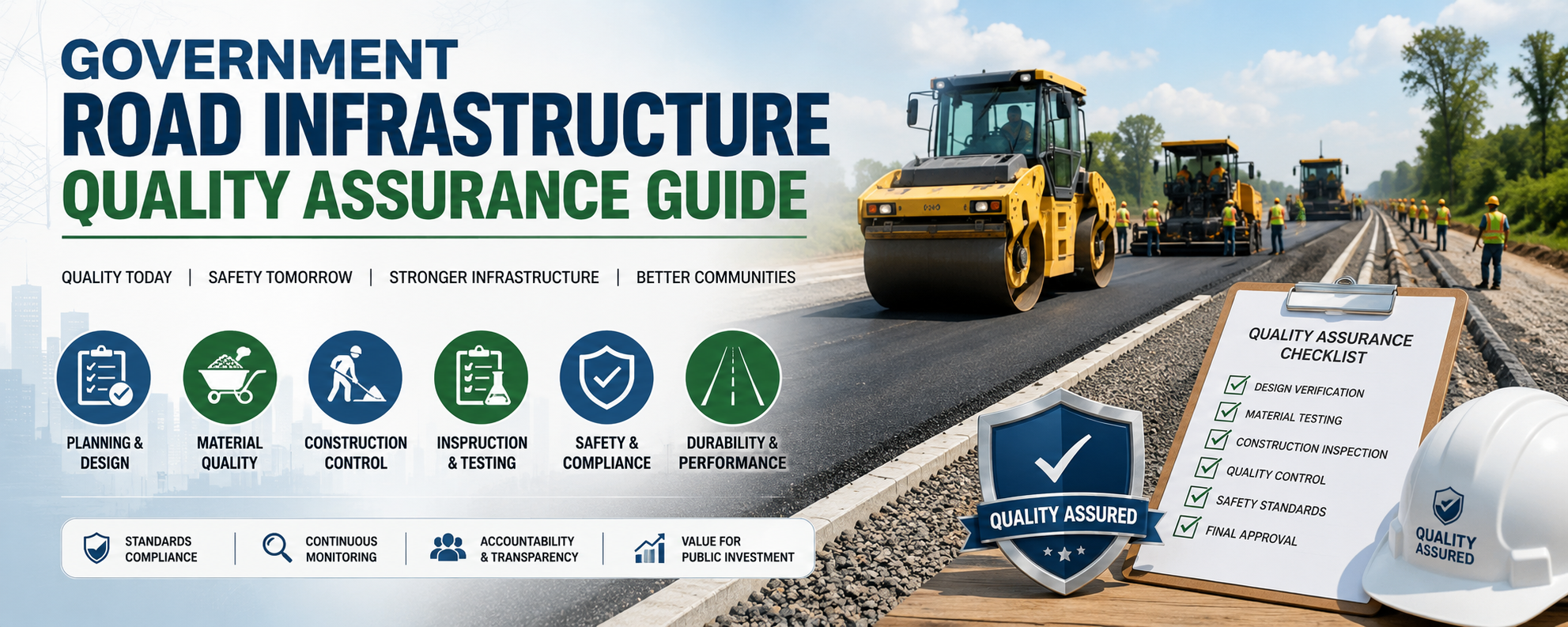

Government road infrastructure plays a vital role in the economic and social development of a country. Roads connect cities, support trade, improve access to education and healthcare, and make everyday travel more convenient. However, building a road is only one part of the process. Ensuring that the road remains safe, durable, and functional for many years requires a strong quality assurance system.
A Government Road Infrastructure Quality Assurance Guide provides a structured approach to maintaining quality throughout the entire lifecycle of a road project. From initial planning and material selection to construction, inspection, testing, and long-term maintenance, every stage must follow clearly defined standards and procedures.
Quality assurance is not simply about finding defects after construction is complete. It is a proactive process designed to prevent problems before they occur. When governments, contractors, engineers, consultants, and inspection teams work together under a well-defined quality framework, public infrastructure can deliver better value, improved safety, and longer service life.
Understanding Quality Assurance in Road Infrastructure
Quality assurance refers to the systematic processes used to ensure that road infrastructure meets established technical, safety, environmental, and performance requirements. It focuses on creating reliable systems that consistently produce acceptable results.
In government-funded road projects, quality assurance is especially important because public money is being invested in infrastructure that is expected to serve communities for decades. Poor-quality construction can lead to cracks, potholes, drainage failures, premature pavement deterioration, and increased maintenance costs.
A strong quality assurance program establishes responsibilities at every level. Government agencies define project requirements and standards, engineers develop designs and specifications, contractors carry out construction activities, and independent inspection or testing teams verify compliance. Clear communication between these stakeholders helps reduce errors and improves accountability.
Planning and Design Quality
The quality of a road begins long before construction equipment arrives at the site. Proper planning and design are fundamental to achieving long-term performance.
Before a project begins, engineers should evaluate traffic volumes, expected vehicle loads, soil conditions, climate, rainfall, terrain, drainage requirements, and future development. Geotechnical investigations are particularly important because the strength and stability of the underlying soil directly influence pavement performance.
Design documents should clearly specify pavement layers, materials, drainage systems, road geometry, safety features, and construction requirements. Designs should also be reviewed by qualified professionals before construction starts. Independent technical reviews can identify potential weaknesses, design conflicts, or unrealistic assumptions at an early stage.
A well-prepared design reduces uncertainty during construction and provides contractors with clear instructions. It also creates measurable benchmarks against which completed work can be evaluated.
Material Quality Control
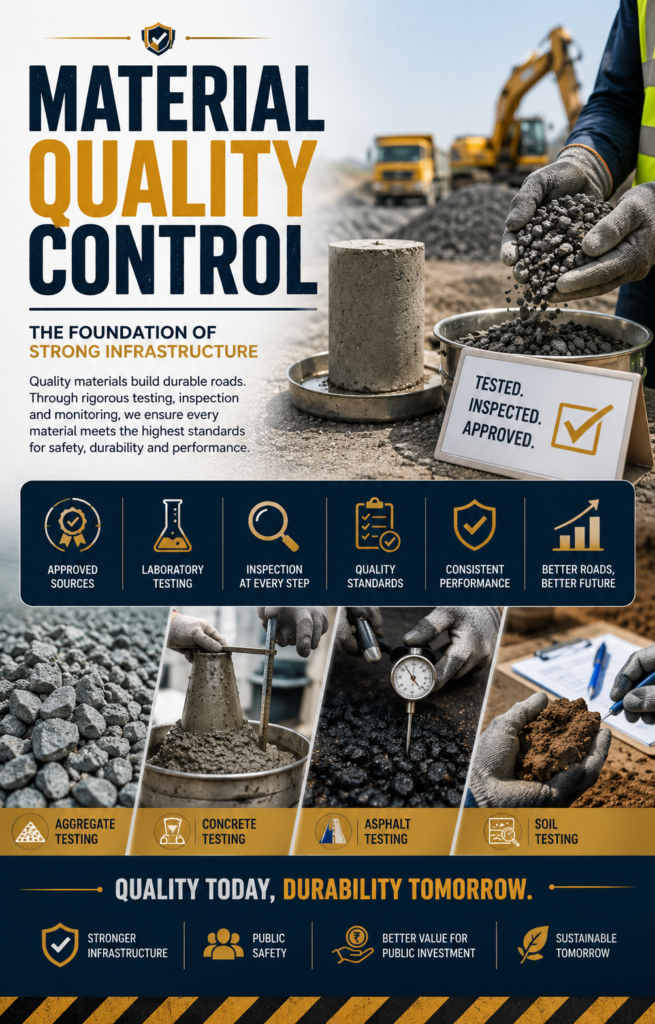
Road construction depends heavily on the quality of materials used. Asphalt, concrete, aggregates, cement, soil, steel, and other construction products must meet specified technical requirements.
Material quality assurance begins with approved suppliers and reliable sourcing. Government authorities and project teams should establish procedures for sampling, testing, storage, transportation, and acceptance of materials.
Aggregates, for example, may need to be tested for grading, strength, durability, cleanliness, and resistance to wear. Asphalt materials may require testing for temperature, composition, performance characteristics, and consistency. Concrete quality can depend on factors such as mix design, water-cement ratio, strength, curing, and placement methods.
Testing should be carried out at appropriate stages rather than relying solely on final inspections. Maintaining accurate laboratory records and test certificates helps establish traceability and provides evidence that materials complied with project requirements.
Quality Control During Construction
Construction quality control is the responsibility of ensuring that work is performed according to approved drawings, specifications, and established procedures. It involves continuous monitoring rather than occasional inspection.
Key activities may include checking excavation levels, verifying subgrade preparation, monitoring pavement layer thickness, controlling compaction, inspecting drainage installations, and ensuring proper asphalt or concrete placement.
Compaction is one of the most important aspects of road construction. Inadequate compaction can result in settlement, deformation, and premature pavement failure. Field density testing and other appropriate methods should therefore be used to confirm that required compaction levels have been achieved.
Construction teams should also maintain daily records covering weather conditions, equipment used, materials delivered, work completed, test results, and any unexpected issues. Detailed documentation helps project managers identify trends and resolve problems before they become major defects.
Inspection and Testing Procedures
Inspection and testing provide objective evidence that construction work meets the required standards. A comprehensive quality assurance program should define what needs to be inspected, when inspections should occur, who is responsible, and what acceptance criteria apply.
Some inspections are performed before work begins, while others take place during construction or after a particular activity is completed. For example, drainage structures may need inspection before backfilling, while pavement layers may be tested before the next layer is placed.
Testing laboratories should use appropriate methods, calibrated equipment, and trained personnel. Test results should be documented and reviewed by authorized project representatives.
When a test result does not meet the required standard, the issue should be formally recorded. Corrective action may include additional testing, repair, removal and replacement, or other approved solutions. The goal should always be to address the underlying cause rather than simply hiding the visible defect.
Drainage and Environmental Considerations
Water is one of the biggest threats to road infrastructure. Poor drainage can weaken pavement foundations, cause erosion, create flooding, and significantly shorten the service life of a road.
Quality assurance procedures should therefore give special attention to side drains, culverts, stormwater systems, bridges, slopes, and other drainage structures. Drainage components must be correctly designed, properly installed, and regularly maintained.
Environmental quality should also be integrated into road infrastructure projects. Construction activities can generate dust, noise, waste, soil erosion, and water pollution. Effective project management should include measures to minimize environmental impacts and comply with applicable regulations.
Sustainable construction practices can further improve long-term outcomes. Using durable materials, optimizing resource consumption, managing construction waste, and considering climate resilience can help governments build infrastructure that performs better under changing environmental conditions.
Safety and Compliance
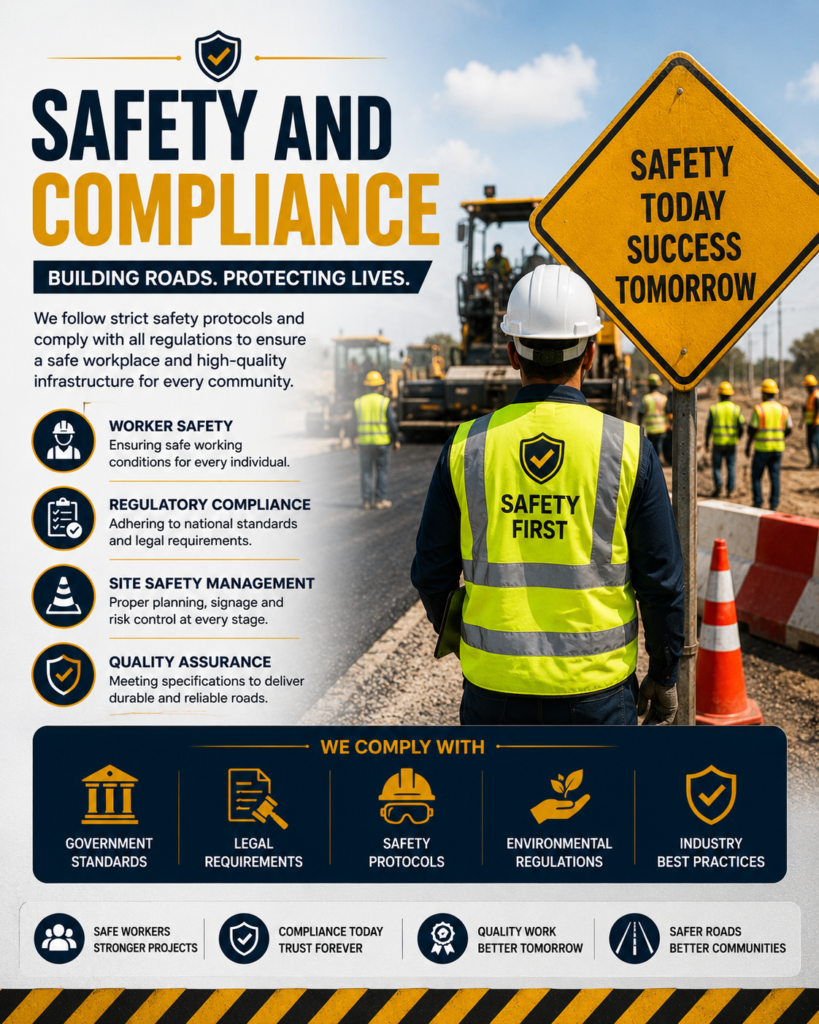
Road infrastructure quality cannot be separated from public safety. A road may appear structurally sound but still create risks if safety features are missing or poorly installed.
Quality assurance should include checks for road markings, signs, guardrails, pedestrian facilities, lighting, intersections, traffic control systems, and other safety elements. Construction zones should also be managed carefully to protect workers and road users.
Compliance with applicable government standards, engineering codes, procurement requirements, and contractual obligations is essential. Project teams should maintain clear records demonstrating that required procedures have been followed.
Documentation and Accountability
Effective documentation is a central part of quality assurance. Every major project decision, inspection, test, approval, non-conformance, and corrective action should be properly recorded.
A complete quality management file may include approved drawings, material certificates, laboratory results, inspection reports, site records, photographs, non-conformance reports, and final completion documents.
Digital project management systems can make this process more efficient. Digital records allow authorized stakeholders to access information quickly, track issues, and improve transparency. They can also support audits and future maintenance planning.
Accountability is strengthened when responsibilities are clearly defined. Each stakeholder should understand what they are responsible for and who has authority to approve or reject work.
Final Inspection and Handover
Before a road project is officially completed, a comprehensive final inspection should be conducted. The inspection should assess the finished infrastructure against approved specifications and contractual requirements.
Any outstanding defects should be documented and corrected before final acceptance, subject to the applicable contractual process. The handover package should include relevant drawings, test results, maintenance information, warranties, and other required documentation.
A proper handover ensures that the agency responsible for operating and maintaining the road has the information needed to manage the asset effectively.
Long-Term Monitoring and Maintenance
Quality assurance does not end when a road opens to traffic. Long-term performance monitoring is essential for protecting public investment.
Government authorities should establish inspection and maintenance programs that identify early signs of deterioration. Routine activities may include cleaning drainage systems, repairing minor pavement defects, maintaining road markings, and inspecting structures.
Periodic condition assessments can help authorities prioritize rehabilitation projects based on actual road performance. Preventive maintenance is often more cost-effective than waiting until significant structural damage occurs.
Data collected through inspections can also improve future road designs. Lessons learned from completed projects should be reviewed and incorporated into updated standards, specifications, and construction practices.
Conclusion
A reliable government road infrastructure system depends on quality assurance at every stage of the project lifecycle. Strong planning, accurate design, quality materials, controlled construction, effective testing, proper drainage, safety compliance, detailed documentation, and ongoing maintenance all contribute to successful road infrastructure.
The most effective quality assurance approach is proactive rather than reactive. Instead of waiting for failures to appear, government agencies and project teams should establish systems that prevent defects, identify risks early, and continuously improve performance.
Ultimately, quality assurance is about protecting public investment and delivering infrastructure that communities can depend on. By implementing clear standards, transparent processes, competent inspections, and long-term asset management, governments can build roads that are safer, more durable, more resilient, and better equipped to support economic growth and public well-being for years to come.