
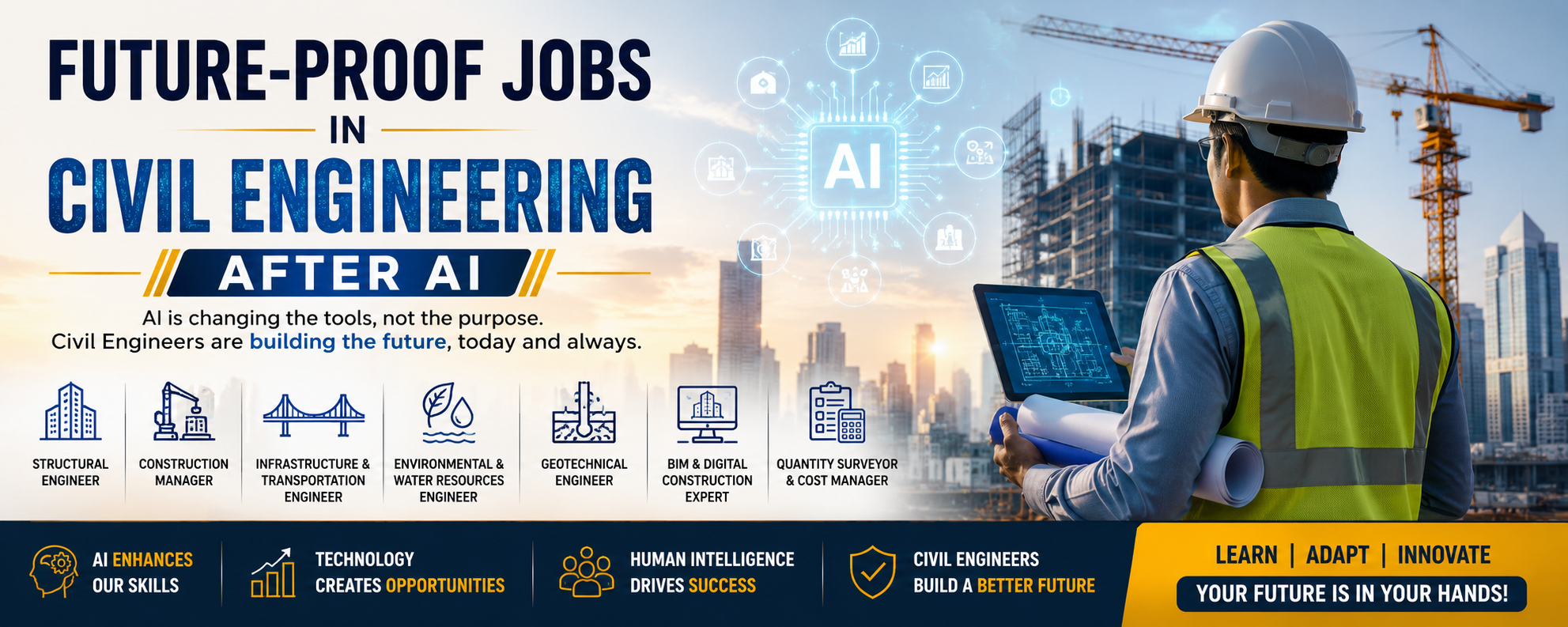

Artificial Intelligence, or AI, is changing the way people work across almost every industry. From software development and marketing to manufacturing and architecture, many traditional tasks are becoming automated or supported by intelligent tools. Naturally, this has created an important question for students who are planning to study civil engineering: Does civil engineering still have a strong future in the age of AI?
The simple answer is yes. Civil engineering is not disappearing because of AI. Instead, the profession is evolving. AI can help engineers analyze information, create designs, identify risks, and automate repetitive tasks, but it cannot completely replace the human responsibility required to plan, build, inspect, and manage real-world infrastructure.
For students, the future of civil engineering is likely to belong to those who combine traditional engineering knowledge with digital skills, practical experience, communication abilities, and problem-solving capabilities.
How AI Is Changing Civil Engineering
AI is already influencing several areas of civil engineering. Engineers can now use advanced software and intelligent systems to analyze large amounts of data, optimize designs, predict maintenance requirements, and improve project planning.
For example, AI-based tools can help identify potential design problems, estimate construction schedules, monitor construction progress, and analyze information from sensors installed in buildings and infrastructure.
However, AI is primarily a tool. It does not automatically understand every real-world situation. A construction site can have unexpected soil conditions, weather problems, labor challenges, material shortages, safety risks, and changes in client requirements.
This is why civil engineers will continue to play an important role. The future engineer will not simply compete against AI. Instead, successful engineers will learn how to work with AI and use it to become faster, smarter, and more productive.
1. Structural Engineering: A Strong Career with Digital Skills
Structural engineering remains one of the most important fields within civil engineering. Structural engineers are responsible for designing buildings, bridges, industrial structures, and other systems that must safely carry loads and withstand environmental conditions.
AI can assist with structural analysis and optimization, but the responsibility for safety cannot simply be handed over to an algorithm. Engineers must understand design principles, building codes, materials, construction practices, and real-world structural behavior.
Students interested in structural engineering should develop strong knowledge of structural analysis and design software while also learning modern technologies such as Building Information Modeling (BIM), computational design, and data-driven analysis.
A future-proof structural engineer will be someone who understands both engineering fundamentals and digital tools.
2. Construction Management: Humans Will Always Be Needed
Construction management is another promising career path for civil engineering students.
AI can help with project scheduling, cost estimation, progress monitoring, and risk prediction. However, construction sites involve people, materials, machines, contractors, consultants, government authorities, and clients.
Managing all these stakeholders requires communication, leadership, negotiation, decision-making, and practical judgment.
A construction manager may have to resolve conflicts between contractors, handle unexpected site conditions, coordinate multiple teams, and make decisions under pressure. These responsibilities require human interaction and accountability.
Students who develop strong leadership and project management skills alongside technical knowledge can build a highly valuable career in the future construction industry.
3. Infrastructure and Transportation Engineering
The world continues to need roads, bridges, metro systems, airports, railways, tunnels, and public transportation networks.
As cities grow, governments and private organizations will continue investing in infrastructure. AI can improve traffic analysis, transportation planning, route optimization, and infrastructure monitoring, but the need for skilled civil engineers will remain.
Future transportation engineers may work with smart traffic systems, intelligent transportation networks, autonomous vehicle infrastructure, and data-driven urban mobility solutions.
Students interested in this field should consider learning GIS, transportation modeling, data analysis, and smart-city technologies.
The combination of civil engineering and technology can create exciting opportunities in the infrastructure sector.
4. Environmental and Water Resources Engineering
5. Geotechnical Engineering: A Field Where Real-World Experience Matters
Climate change, water scarcity, flooding, pollution, and waste management are becoming increasingly important global challenges.
Civil engineers specializing in environmental and water resources engineering can contribute to solving these problems through sustainable infrastructure and resource management.
AI can help analyze environmental data and predict patterns, but engineers are still required to design practical solutions and implement them in the real world.
Future opportunities may include sustainable water systems, wastewater treatment, flood management, climate-resilient infrastructure, renewable energy projects, and environmental planning.
For students who want their engineering career to have a positive impact on society, this can be a particularly meaningful specialization.
Geotechnical engineering deals with soil, rocks, foundations, slopes, tunnels, and underground conditions.
This is an area where practical site knowledge remains extremely valuable. Soil conditions can vary significantly from one location to another, and actual site behavior may not always match theoretical assumptions or historical data.
AI can assist with data analysis and prediction, but experienced engineers are still needed to interpret site investigations and make professional decisions.
Students interested in geotechnical engineering should develop knowledge of soil mechanics, foundation engineering, site investigation, and modern testing technologies.
Combining field experience with digital analysis can make a geotechnical engineer highly valuable in the future.
6. BIM and Digital Construction
One of the most promising career directions for civil engineering students is Building Information Modeling (BIM).
BIM allows project teams to create and manage digital representations of buildings and infrastructure. It can improve coordination between architects, structural engineers, MEP consultants, contractors, and clients.
As construction projects become more digitally connected, professionals with BIM expertise are likely to have strong opportunities.
Students should consider learning tools related to BIM, 3D modeling, digital coordination, and construction information management.
The future may not be about choosing between civil engineering and technology. Instead, it may be about becoming a civil engineer who understands technology better than others.
7. Quantity Surveying and Cost Management
Construction projects involve significant financial investment. Controlling costs, preparing estimates, managing contracts, and evaluating project quantities are essential responsibilities.
AI can automate some calculations and assist in cost forecasting, but professionals are still needed to understand contracts, project risks, market conditions, and commercial relationships.
Students interested in this area can build valuable skills in quantity surveying, construction economics, contract management, and cost control.
Learning digital estimation and project management tools can make these professionals even more competitive.
8. Government and Public Infrastructure Jobs
Government organizations will continue to require civil engineers because public infrastructure cannot be developed and maintained without technical professionals.
Engineers may work in departments responsible for roads, highways, railways, water supply, urban development, housing, and public buildings.
AI may improve government project monitoring and planning, but engineers will still be needed for inspections, approvals, technical decisions, quality control, and infrastructure management.
Students preparing for government careers should focus on strong technical fundamentals, relevant examinations, engineering standards, and practical knowledge.
The Most Important Skill: Adaptability
The biggest mistake a civil engineering student can make is assuming that learning a degree is enough for an entire career.
Technology will continue to change. Software that is popular today may be replaced by better tools tomorrow. Therefore, students should focus on becoming adaptable learners.
A future-ready civil engineer should understand engineering fundamentals, but should also be comfortable learning new software, analyzing data, using AI tools, communicating with teams, and solving unfamiliar problems.
The goal should not be to become an expert in every technology. Instead, students should learn how technology can improve their specific area of engineering.
What Should Civil Engineering Students Learn Today?
Students who want to prepare for the future can focus on a combination of technical and professional skills.
Important areas include:
- Structural and construction fundamentals
- AutoCAD and technical drawing
- BIM and 3D modeling
- Project management
- Data analysis
- GIS and mapping technologies
- Quantity estimation and cost management
- Construction safety
- Sustainable design
- AI-assisted engineering tools
- Communication and leadership
Practical internships are equally important. Spending time on actual construction sites can teach students things that cannot be fully understood through textbooks or software.
Will AI Replace Civil Engineers?
AI will probably replace some tasks, but it is unlikely to replace the entire profession.
Routine calculations, repetitive documentation, basic analysis, and certain administrative activities may become increasingly automated. This means engineers who only perform repetitive tasks may face greater pressure to adapt.
However, civil engineering involves physical infrastructure, public safety, regulations, environmental conditions, professional responsibility, and human coordination.
A bridge still needs to be built. A road still needs to be inspected. A foundation still needs to be constructed. A construction team still needs leadership.
AI can support these processes, but humans will remain responsible for making decisions and ensuring that infrastructure works safely in the real world.
The Future Belongs to Hybrid Engineers
The future of civil engineering is not AI versus engineers. It is engineers using AI.
Students who learn only traditional methods may find it harder to compete in a rapidly changing industry. On the other hand, students who combine strong engineering fundamentals with digital knowledge, AI awareness, practical experience, and human skills can become highly valuable professionals.
The most future-proof civil engineering career will likely belong to the hybrid engineer—someone who understands how structures, materials, construction, infrastructure, people, and technology work together.
So, if you are a student wondering whether civil engineering has a future after AI, there is no need to lose confidence. The industry is changing, but the need to build safe, sustainable, and efficient infrastructure is not going away.
Learn the fundamentals. Understand technology. Use AI as a tool. Gain real-world experience. Keep learning.
That combination can help you build not just a career in civil engineering, but a career that remains relevant in the future.