
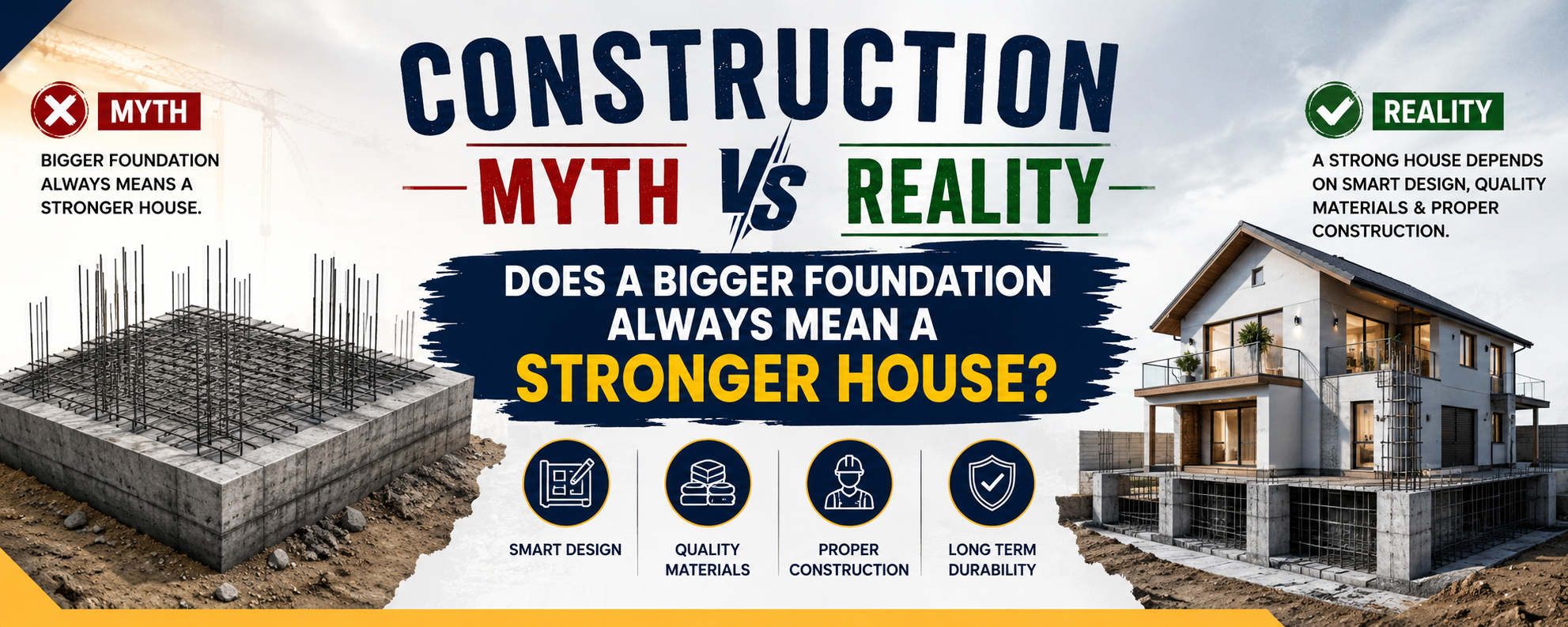

When planning a dream home, many homeowners believe that a bigger foundation automatically means a stronger house. It sounds logical—if a larger foundation supports more weight, it must be stronger, right? However, this is one of the most common misconceptions in residential construction.
The truth is that a stronger house foundation is not determined by size alone. Instead, it depends on engineering design, soil conditions, material quality, construction techniques, and proper load distribution. An oversized foundation that is poorly designed can perform worse than a correctly engineered foundation of standard dimensions.
In this article, we’ll separate myth from reality and explain what truly makes a foundation strong and durable.
The Myth
“The bigger the foundation, the stronger the house.”
Many homeowners assume that increasing the width or depth of a foundation automatically increases the strength and lifespan of a building. Some even request contractors to make foundations larger than recommended, believing it provides extra safety.
While this belief is common, it ignores one important fact:
Every house requires a foundation designed specifically for its structural load and soil conditions.
Bigger isn’t always better—it can actually become an unnecessary expense if it isn’t backed by proper engineering.
The Reality
A stronger house foundation is created through proper engineering—not simply by increasing its size.
Structural engineers calculate foundation dimensions after considering several factors, including:
- Soil bearing capacity
- Total building load
- Number of floors
- Type of structure
- Groundwater level
- Local climate
- Seismic (earthquake) zone
- Building codes
If these factors are ignored, even a massive foundation can develop cracks, settlement issues, or structural instability over time.
The goal isn’t to build the biggest foundation—it is to build the right foundation.
Why Foundation Design Matters
The foundation transfers the weight of your house safely into the ground.
If it is too small, it may fail under heavy loads.
If it is unnecessarily large, it increases construction costs without providing meaningful structural benefits.
A professionally designed foundation achieves the perfect balance between safety, performance, and cost efficiency.
Factors That Actually Make a Foundation Strong
1. Soil Testing Before Construction
Every plot has different soil characteristics.
Some soils can safely carry heavy loads, while others require special foundation designs.
A soil investigation helps engineers determine:
- Soil bearing capacity
- Water table level
- Settlement risk
- Suitable foundation type
Skipping soil testing often leads to expensive structural repairs later.
2. Proper Structural Design
Every home is unique.
A single-story home requires a different foundation than a three-story building.
Engineers calculate:
- Dead loads
- Live loads
- Wind loads
- Earthquake loads
These calculations ensure the foundation safely supports the structure throughout its life.
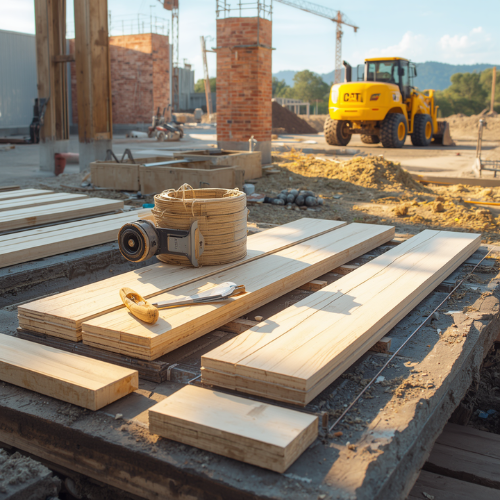
3. Quality Construction Materials
Even a perfectly designed foundation can fail if poor-quality materials are used.
Essential materials include:
- High-grade cement
- Clean sand
- Properly graded aggregates
- Certified TMT steel bars
- Clean water for mixing concrete
Quality materials significantly improve durability and long-term performance.
4. Correct Concrete Mix
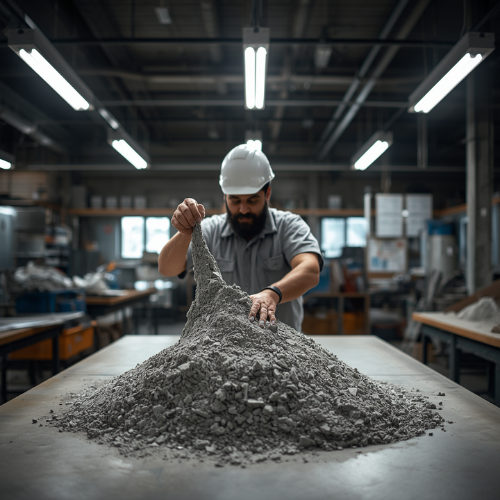
Many people believe adding more cement automatically makes stronger concrete.
This is another myth.
Concrete strength depends on:
- Correct mix proportion
- Water-cement ratio
- Proper mixing
- Proper compaction
- Adequate curing
A balanced mix provides much better strength than simply increasing cement content.
5. Proper Reinforcement
Steel reinforcement absorbs tensile forces that concrete alone cannot handle.
Incorrect bar spacing, insufficient cover, or poor steel placement can weaken the foundation regardless of its size.
Professional reinforcement detailing is essential for structural safety.
6. Proper Curing
Concrete continues gaining strength for several weeks after pouring.
Without proper curing, it may:
- Crack early
- Lose strength
- Become porous
- Allow moisture penetration
Maintaining moisture for the recommended curing period is one of the simplest ways to improve foundation durability.
When a Bigger Foundation May Be Necessary
Although bigger foundations aren’t always better, there are situations where larger foundations are required.
Examples include:
- Multi-story buildings
- Heavy industrial structures
- Weak soil conditions
- High groundwater levels
- Basements
- Large column loads
In these cases, engineers intentionally design larger foundations based on calculations—not assumptions.
The Cost of Oversized Foundations
Many homeowners think spending more on a larger foundation guarantees extra safety.
Unfortunately, oversized foundations often result in:
- Higher excavation costs
- Increased concrete consumption
- More reinforcement steel
- Longer construction time
- Higher labor expenses
If the foundation size exceeds engineering requirements, the additional investment may provide little to no structural benefit.
Smart construction focuses on efficient engineering, not unnecessary oversizing.
Common Signs of a Poor Foundation
Regardless of size, a poorly designed or poorly built foundation may develop problems such as:
- Wall cracks
- Uneven floors
- Doors and windows that don’t close properly
- Water seepage
- Settlement around the building
- Structural movement
These issues usually result from poor planning, inadequate soil assessment, or construction defects—not from a lack of foundation size alone.
Expert Tips for Homeowners
Before starting construction, follow these best practices:
- Conduct a professional soil test.
- Hire a qualified structural engineer.
- Use quality-certified construction materials.
- Follow approved structural drawings.
- Never alter foundation dimensions without engineering approval.
- Ensure proper concrete curing.
- Work with experienced construction professionals who prioritize quality over shortcuts.
These steps contribute far more to a stronger house foundation than simply making it larger.
Final Verdict: Myth vs Reality
Myth: A bigger foundation always creates a stronger house.
Reality: A stronger house foundation is the result of proper engineering, quality materials, soil analysis, and correct construction practices—not merely larger dimensions.
Every successful home starts with a foundation designed specifically for its site and structural requirements. Oversizing a foundation without technical justification only increases costs while offering little additional value.
If you want a home that remains safe, durable, and structurally sound for generations, focus on expert planning and professional execution rather than construction myths. Remember, the strongest foundation isn’t the biggest one—it’s the one that’s engineered correctly.