

Rainwater Harvesting for Residential Buildings: A Smart Investment for Every Homeowner
Imagine watching thousands of litres of clean rainwater flow from your roof directly into the drain every monsoon. Within a few months, the same household starts depending entirely on municipal water or expensive borewell systems. This is the reality in many Indian cities today. While water scarcity is becoming a growing concern, every rainfall offers an opportunity to collect one of nature’s most valuable resources—for free.
Rainwater harvesting is no longer an optional environmental practice reserved for large institutions or commercial projects. It has become an intelligent feature for modern residential buildings that helps homeowners reduce water dependency, lower utility costs, and contribute to groundwater conservation. A well-designed rainwater harvesting system works silently in the background, collecting and storing water that would otherwise go to waste.
If you are planning to build a new home, this is the perfect time to include rainwater harvesting in your construction plan rather than treating it as an afterthought.
Every Roof Is a Natural Water Collector
Many homeowners don’t realize that the roof of their house is already a ready-made water collection surface. During every rainfall, hundreds or even thousands of litres of water fall on the roof. Instead of allowing that water to enter the drainage system, it can be directed into storage tanks or groundwater recharge pits.
For example, a roof area of approximately 1,000 square feet can collect a significant quantity of rainwater during the monsoon season. With proper planning, this water can be used for gardening, vehicle washing, floor cleaning, toilet flushing, and, after suitable filtration and treatment, even for domestic purposes where permitted.
Instead of seeing rain as a seasonal event, homeowners should see it as an annual opportunity to secure a valuable water reserve.
Why Future Homes Must Think Beyond Municipal Water
Urban populations continue to grow while groundwater levels continue to decline. Many cities already face seasonal water shortages, forcing residents to depend on water tankers or deeper borewells.
A home designed with rainwater harvesting is better prepared for these challenges. It becomes more self-reliant because it captures a portion of its own water requirement instead of relying entirely on external sources.
This not only increases water security for your family but also supports the community by reducing pressure on public water infrastructure.
A sustainable home isn’t only energy-efficient—it is also water-efficient.
Understanding How the System Actually Works
One of the biggest misconceptions is that rainwater harvesting is a complicated engineering system. In reality, its working principle is surprisingly simple.
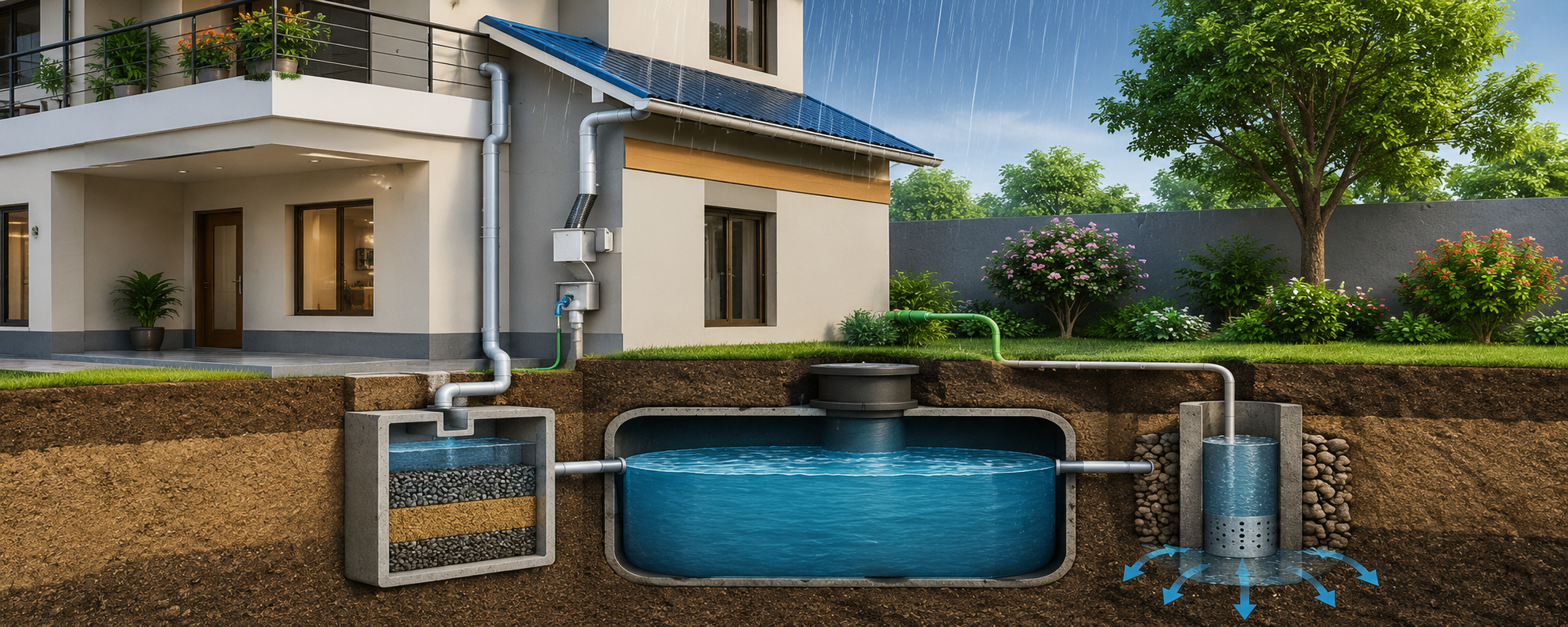
Rainwater first falls on the roof, which acts as the collection surface. It then flows through specially designed gutters and downpipes. Before entering storage or recharge systems, the water passes through filters that remove leaves, dust, and other debris.
Depending on the design, the filtered water follows one of two paths. It is either stored inside underground or overhead tanks for future use, or it is directed into recharge pits where it slowly enters the soil and replenishes groundwater reserves.
This entire process requires very little manual intervention once installed correctly.
Planning During Construction Makes All the Difference
Many homeowners decide to install rainwater harvesting years after construction is complete. Although possible, retrofitting often involves additional excavation, plumbing modifications, and higher installation costs.
Planning the system while designing the house offers several advantages.
Architects can determine the ideal roof slopes for efficient water collection. Underground storage tanks can be integrated into the landscape without affecting aesthetics. Drainage pipelines can be concealed inside walls and foundations, creating a cleaner appearance while reducing future maintenance.
Most importantly, early planning saves both money and construction time.
A home designed with water management in mind is always more efficient than one modified later.
Common Mistakes That Reduce Water Collection
Installing a rainwater harvesting system alone does not guarantee good performance. Several common mistakes reduce its effectiveness.
Many homeowners ignore regular cleaning of rooftop surfaces and gutters, allowing dirt and leaves to contaminate the collected water. Some choose storage tanks that are too small, causing valuable rainwater to overflow during heavy rainfall.
Improper filter selection is another frequent issue. Without quality filtration, sediments enter the storage system and reduce water quality.
Poorly designed recharge pits may fail to absorb water efficiently due to incorrect soil assessment or insufficient depth.
Professional planning ensures these problems are avoided before construction even begins.
Rainwater Harvesting Is Also a Financial Decision
Most discussions focus only on environmental benefits, but rainwater harvesting also provides strong financial advantages.
Using harvested rainwater for non-drinking purposes reduces dependence on municipal water supply and borewell pumps. Lower water consumption often results in reduced utility expenses over the years.
Groundwater recharge also helps maintain borewell performance, reducing the likelihood of expensive drilling in the future.
In many regions, sustainable homes equipped with rainwater harvesting systems are increasingly preferred by buyers because they promise lower operating costs and responsible resource management.
Instead of viewing it as an additional expense, homeowners should consider it a long-term investment that continues generating value every monsoon season.
Why Professional Design Matters More Than Equipment
Buying filters, tanks, and pipes is easy. Designing an efficient rainwater harvesting system is where expertise matters.
Every property has unique characteristics including plot size, roof area, rainfall pattern, soil type, drainage layout, and family water requirements. A standardized solution rarely delivers the best results.
Professional architects calculate expected water collection capacity, determine appropriate storage sizes, identify ideal recharge locations, and integrate the entire system into the home’s architectural design without compromising aesthetics.
Good planning ensures the system remains efficient for decades rather than requiring repeated modifications.
How Kanakdhara Developer Builds Water-Smart Homes
At Kanakdhara Developer Private Limited, we believe modern homes should be designed not only for today’s lifestyle but also for tomorrow’s environmental challenges. Our architectural and construction experts integrate rainwater harvesting into the initial planning stage so that homeowners receive a complete water management solution instead of an expensive retrofit.
From calculating roof water collection potential and designing efficient drainage networks to planning underground storage tanks, recharge pits, filtration systems, and landscape integration, every element is carefully customized according to the plot size and family requirements.
Our team also combines rainwater harvesting with smart plumbing layouts, sustainable construction practices, and energy-efficient home design, ensuring that every house delivers long-term savings, environmental responsibility, and higher property value.
For us, sustainability is not an extra feature—it is an essential part of quality home construction.
Conclusion
Rainwater harvesting is one of the smartest additions a homeowner can make to a residential building. It transforms ordinary rainfall into a valuable resource, reduces dependence on external water supplies, supports groundwater recharge, lowers long-term water expenses, and prepares homes for future water challenges.
The best time to implement a rainwater harvesting system is during the design and construction phase, when every component can be integrated seamlessly into the building. By planning ahead, homeowners not only protect a precious natural resource but also increase the efficiency, sustainability, and value of their property.
If you are planning your dream home, let Kanakdhara Developer Private Limited help you create a residence that is not only beautiful and durable but also environmentally responsible. Because a truly modern home is one that respects every drop of water and uses it wisely for generations to come.