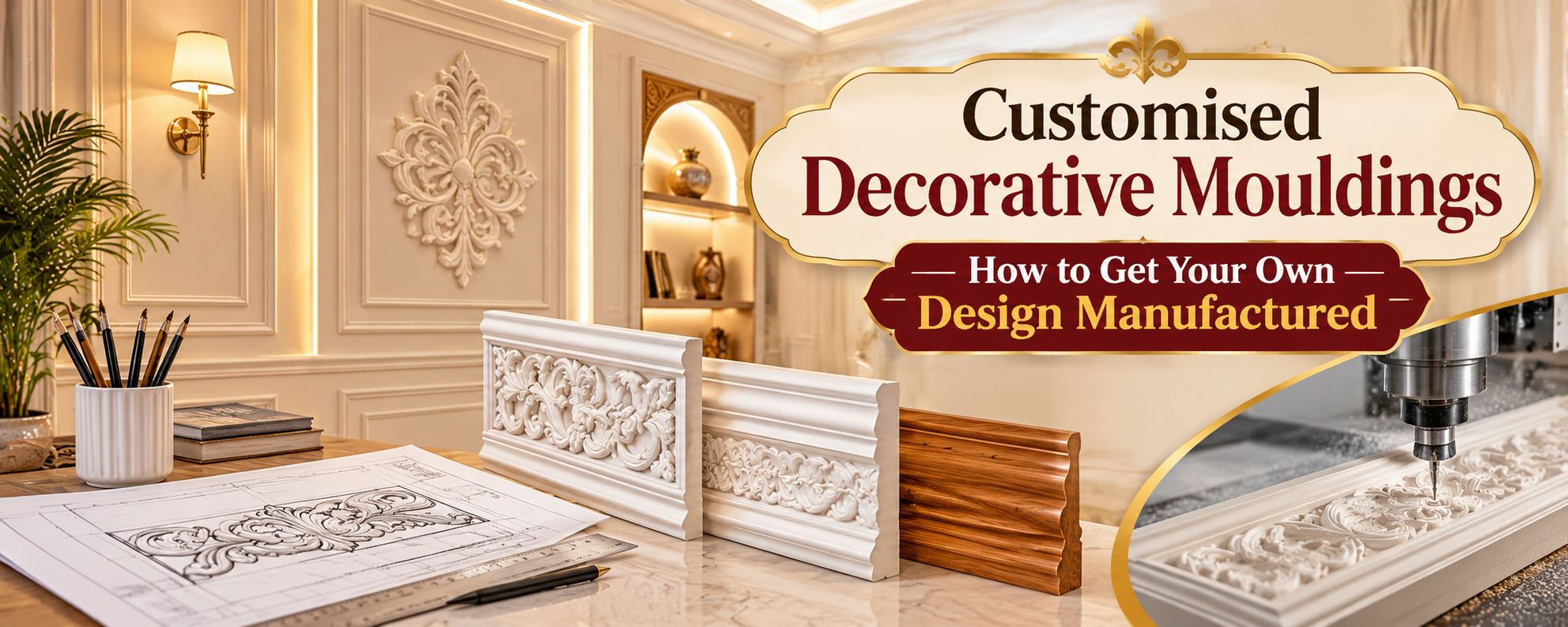

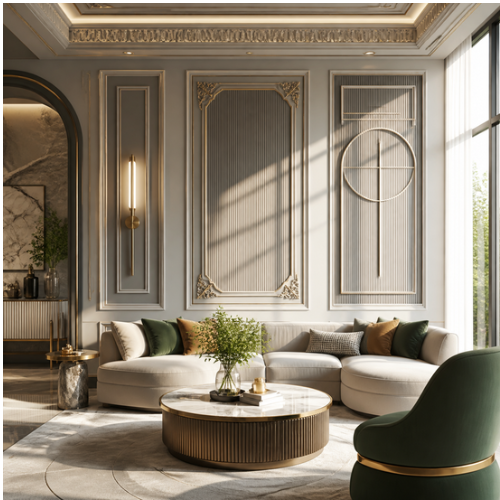
This is one of the most interesting options available to homeowners.
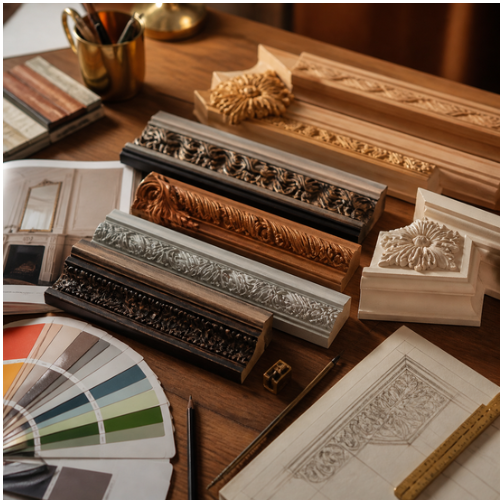
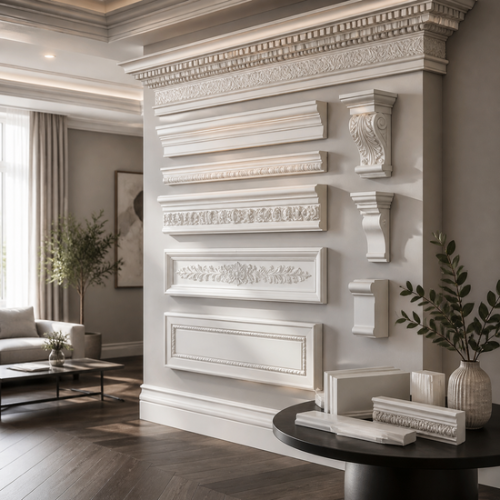
You do not have to select only the designs displayed in a showroom. If you have a particular architectural style in mind, you can approach a manufacturer to develop a customised moulding.
For example, you may have seen a beautiful wall design in a hotel, palace-inspired interior, luxury villa or international interior design photograph. You can share that reference with a manufacturer and ask whether a similar profile can be developed.
However, not every design can be manufactured using every material. The production method depends on the complexity, dimensions and required finish.
What Types of Customisation Are Available?
1. Custom Wall Frame Designs
You can customise the width, thickness, corner patterns and overall arrangement of rectangular or geometric wall frames.
For example, instead of using standard rectangular moulding, you can create a combination of large central frames and smaller decorative corner profiles.
2. Custom Floral and Ornamental Designs
If you prefer a traditional or royal interior, you can request floral motifs, leaf patterns, ornamental corners and classical decorative details.
These designs can be developed using suitable casting or mould-making techniques.
3. Custom Ceiling Cornices
Ceiling cornices can be manufactured according to your preferred height, projection, width and decorative pattern.
You can also request profiles designed to accommodate LED lighting, provided the manufacturer develops the required channel and installation details.
4. Custom Door and Window Surrounds
You can create decorative architraves, door crowns, window borders and classical surrounds according to the dimensions of your openings.
This is particularly useful when you want the same architectural language throughout your house.
5. Custom 3D Wall Profiles
Some manufacturers and fabrication workshops can develop three-dimensional decorative elements using CNC machining, casting or specialised moulding processes.
You can select different depths, shapes, textures and surface finishes according to the interior concept.
How to Order a Customised Moulding: Step-by-Step Process
Step 1: Share a Design Reference
Provide a photograph, sketch, architectural drawing or reference image of the moulding you want.
Step 2: Finalise Dimensions
Specify the required width, height, thickness, projection and overall length.
Step 3: Select the Material
Discuss whether the design is suitable for PU, POP, PVC, WPC, GRG or wood.
Step 4: Approve a Sample or Prototype
Ask the manufacturer to produce a sample or prototype before approving bulk production.
Step 5: Manufacture and Install
Confirm production quantity, delivery, installation method, joint finishing and painting requirements.
Does Customised Moulding Cost More?
Generally, customised designs can cost more than ready-made products, especially when a new mould, master pattern or CNC programme is required.
However, the cost depends on the manufacturing method and production quantity.
For example, if you need only two ornamental corners, developing a completely new casting mould may be expensive. But if you require the same design for an entire house or multiple projects, the initial development cost can be distributed across more pieces.
Before placing the order, ask the manufacturer about:
One-time mould or pattern development charges.
Prototype and sample costs.
Minimum production quantity.
Cost per running foot or piece.
Production time.
Packaging and transportation.
Possibility of future repeat orders.
Practical tip: Ask the manufacturer to retain the approved design reference, dimensions and mould specification for future orders. This can make replacement and repeat production easier.
How to Identify Good-Quality Decorative Mouldings Before Purchasing
A decorative moulding may look attractive in a catalogue, but its actual quality becomes clear only when you inspect the product closely.
Poor-quality profiles can create uneven wall lines, visible joints, surface defects and installation difficulties.
Here are important checks to perform before purchasing.
Check the Surface Finish
The profile should have a reasonably smooth and consistent surface, unless the design intentionally includes a textured finish.
Look for bubbles, dents, cracks, rough edges, manufacturing marks and unwanted surface irregularities.
Check Dimensional Accuracy
Measure the width, height, thickness and length of the profile.
If you are purchasing multiple pieces of the same design, check whether their dimensions are consistent.
Even small differences can create alignment problems when multiple profiles are installed together.
Check the Material Density and Strength
Do not assume that a heavier product is always better or that a lightweight product is always inferior.
Each material has different physical properties. For example, PU and EPS are lightweight materials, while GRG and certain plaster products have different weight and strength characteristics.
Ask for the manufacturer’s technical specifications and a sample wherever possible.
Check Moisture Resistance
For bathrooms, utility areas and other moisture-prone locations, material suitability is important.
Do not install ordinary POP or untreated wood in damp conditions without an appropriate protection system and professional assessment.
Even moisture-resistant materials require suitable installation and sealing.
Check Paint Compatibility
If you want white, cream, beige, gold or another custom colour, confirm whether the moulding can be painted.
Ask whether it requires a specific primer, surface preparation or compatible paint system.
Check Fire Performance
Some polymer and foam-based decorative materials can be combustible.
For products used in ceilings, escape routes or other safety-sensitive locations, obtain appropriate fire-performance documentation and ensure that the complete installation complies with applicable building and fire-safety requirements.
Which Decorative Moulding Material Is Best for Different Areas of Your Home?
Not every material is suitable for every location. Selection should depend on exposure conditions, design requirements and maintenance expectations.
Home area | Suitable options | Important consideration |
|---|---|---|
Living room walls | PU, POP, PVC, wood | Match the profile with wall design |
Bedroom feature wall | PU, POP, WPC, wood | Avoid excessive decorative thickness |
Ceiling borders | PU, POP, GRG, EPS | Check weight and fixing system |
Bathroom interiors | Suitable PVC or moisture-rated systems | Avoid ordinary moisture-sensitive products |
Entrance and foyer | PU, GRG, wood, POP | Consider the architectural theme |
Door surrounds | Wood, PU, POP | Check opening dimensions |
Dining area | PU, POP, wood | Coordinate with lighting and furniture |
TV feature wall | WPC, PU, PVC, wood | Coordinate with cable and service access |
Decorative columns | GRG, PU, POP, wood | Confirm support and fixing details |
Popular Decorative Moulding Design Ideas for Different Rooms
The material is only one part of the selection. The design and its placement determine how attractive the final interior will look.
Living Room: Classical Wall Frames
Use symmetrical rectangular wall frames behind the sofa or on the main feature wall. Combine them with subtle paint shades, suitable lighting and balanced furniture arrangements.
For a more luxurious appearance, you can use double-border mouldings or ornamental corner pieces.
Bedroom: Decorative Headboard Wall
A decorative moulding frame behind the bed can create a premium focal point.
You can combine mouldings with upholstered panels, wallpaper or textured paint.
Avoid placing too many ornamental elements around the headboard because the wall should remain visually comfortable.
Entrance: Arch and Decorative Surrounds
Decorative arches and pilasters can make the entrance feel more distinctive.
Use them around selected openings rather than creating unnecessary decorative structures throughout the passage.
Ceiling: Cornice and Medallion Designs
A ceiling medallion around a chandelier can create a traditional focal point, while simple cornices provide a neat transition between walls and ceilings.
Ensure that the ceiling structure can support the selected decorative element and that the installation does not interfere with electrical fittings.
Dining Area: Elegant Wall Borders
Use decorative wall frames to create a more formal dining environment.
The size of the frames should be coordinated with the dining table, wall lights and furniture arrangement.
How Much Budget Should You Keep for Decorative Moulding Work?
Before purchasing decorative mouldings, calculate the total wall or ceiling area where you want to install them.
For example, suppose you have a living room wall measuring 12 ft wide and 9 ft high. You want to install four rectangular decorative frames using a simple moulding profile.
Assume the total perimeter of all four frames is 100 running feet.
If the selected profile costs ₹50 per running foot, the basic material cost will be:
However, the final project cost will also include cutting, corner joints, adhesive, installation labour, surface finishing and painting.
A practical budget calculation should include the following:
Cost component | What to consider |
|---|---|
Material | Price per running foot or piece |
Wastage | Extra material for cutting and damaged pieces |
Adhesive | Product suitable for the selected material |
Labour | Installation and alignment charges |
Joint finishing | Filling, sanding and corner finishing |
Painting | Primer, paint and decorative finish |
Transportation | Delivery and handling |
Taxes | Applicable GST |
For customised designs, add the cost of pattern development, mould creation and prototype production wherever applicable.
My recommendation: Keep a separate budget for decorative mouldings during the interior planning stage. This will help you select the right material and design without compromising other important construction requirements.
Common Mistakes to Avoid When Selecting Decorative Mouldings
Decorative mouldings can improve the appearance of a home, but incorrect selection may make interiors look overcrowded or poorly finished.
Choosing oversized mouldings for small rooms: Large ornamental profiles can overwhelm compact bedrooms and living rooms. Select dimensions according to wall size and ceiling height.
Ignoring the interior theme: Traditional floral mouldings may not complement every minimalist or contemporary interior. Maintain consistency between furniture, lighting, colours and decorative profiles.
Selecting material only on the basis of price: Low-cost products may have inconsistent dimensions, poor surface quality or unsuitable performance for the intended location.
Installing mouldings on damp walls: Moisture can damage plaster-based materials, affect adhesives and create paint failure. Resolve the moisture source first.
Ignoring corner joints: Poorly cut corners and uneven joints can make even premium mouldings look cheap.
Not checking the final sample: Catalogue photographs may not accurately represent the actual colour, texture and thickness. Always inspect a physical sample before bulk ordering.
Overusing decorative elements: Every wall does not need mouldings. A few well-designed areas often look more premium than excessive decoration.
Ignoring lighting arrangements: Decorative profiles can create shadows and affect how wall lights, downlights and LED strips appear. Plan lighting and moulding together.
How to Choose the Right Decorative Mouldings According to Your Budget
You do not need an unlimited budget to create beautiful interiors. The important thing is to select suitable materials and concentrate decoration in the areas that matter most.
Budget category | Recommended approach | Suitable products |
|---|---|---|
Economical | Simple borders and limited wall frames | Basic POP and PVC profiles |
Mid-range | More detailed wall frames and selected ceiling borders | PU, quality PVC and selected WPC profiles |
Premium | Customised profiles, detailed cornices and feature walls | Premium PU, GRG and wooden mouldings |
Luxury | Bespoke architectural elements and ornamental detailing | Custom GRG, carved wood and specialised PU designs |
For a budget-friendly home, concentrate on the living room feature wall and bedroom headboard wall.
For a premium home, you can coordinate wall mouldings, ceiling cornices, door surrounds and selected ornamental details throughout the house.
For a luxury villa, customised mouldings can be developed to match the architectural concept, furniture design and overall interior theme.
The goal should be to create a consistent design language rather than using expensive materials everywhere.
Frequently Asked Questions
1. Can I get decorative mouldings manufactured according to my own design?
Yes. Many decorative moulding manufacturers offer customised designs based on photographs, sketches, CAD drawings or 3D references. You can choose the pattern, dimensions, thickness, material and finish according to your interior requirements.
2. How can I order customised wall mouldings from a manufacturer?
First, share your design reference with the manufacturer. Finalise the required dimensions, material, profile thickness and finish. Ask for a sample or prototype, approve the design and then confirm the production quantity, price and delivery timeline.
3. Which materials are available for customised decorative mouldings?
Customised mouldings can be manufactured using PU, POP, PVC, WPC, wood, GRG and other suitable materials. The selection depends on design complexity, intended location, durability requirements, moisture exposure and budget.
4. Can manufacturers create moulding designs from a photograph?
Yes. Some specialised manufacturers can use reference photographs to develop similar decorative profiles. However, a photograph may not provide accurate dimensions or manufacturing details, so the manufacturer may need a drawing, measurements or a physical sample.
5. Is customised moulding more expensive than ready-made moulding?
Generally, customised mouldings can cost more because of design development, mould creation, prototyping and specialised manufacturing. However, bulk production can reduce the average cost per piece, particularly when the same design is required throughout a house.
6. What is the minimum order quantity for customised mouldings?
The minimum order quantity depends on the manufacturer, material and production technique. Some workshops may accept small customised orders, while others require larger quantities to cover mould development and manufacturing costs. Confirm the minimum quantity before placing an order.
7. Can I customise the size, thickness and pattern of decorative mouldings?
Yes. Depending on the manufacturing method, you can customise the profile width, height, thickness, projection, length, corner detailing and ornamental pattern. Always approve the final dimensions and sample before bulk production.
8. How much time does it take to manufacture customised decorative mouldings?
Production time depends on design complexity, mould development, material availability and order quantity. Standard profiles may be available immediately, while completely new designs may require additional time for drawing approval, prototype development and manufacturing.
9. Can customised mouldings be manufactured to match my furniture and interior design?
Yes. You can share your furniture design, wall elevations, colour scheme and interior references with the manufacturer. They can help develop matching moulding profiles for wardrobes, headboard walls, door frames, ceiling borders and decorative wall panels.
10. What should I check before approving a customised moulding order?
Check the approved sample, material specifications, dimensions, surface finish, manufacturing quality, price, minimum order quantity, delivery schedule and installation requirements. Also clarify whether mould development charges, transportation, painting and installation are included in the quotation.