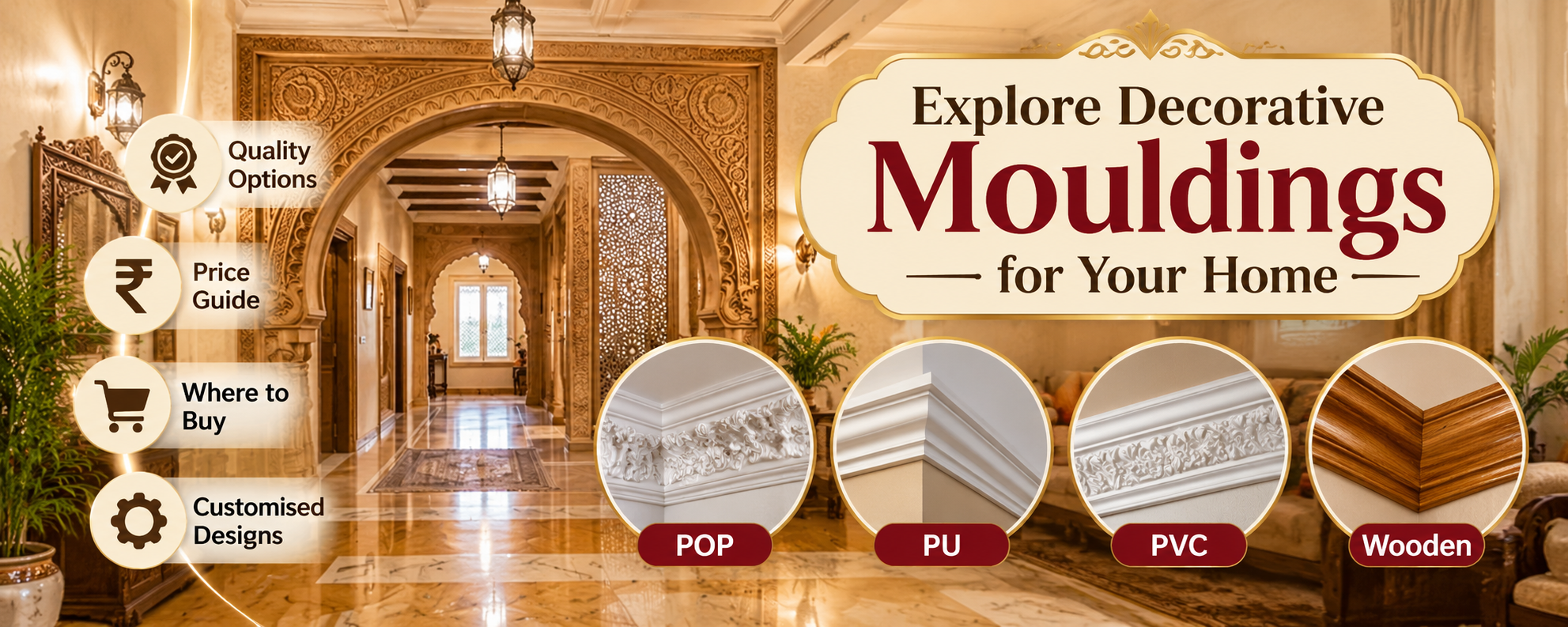

A beautiful home is not created only through expensive furniture, premium flooring or attractive wall colours. Sometimes, small architectural details make the biggest difference in the overall appearance of an interior. Decorative mouldings are one such design element that can transform ordinary walls, ceilings, doors and furniture into elegant and visually interesting spaces.
Today, homeowners have access to a wide variety of ready-made decorative products that can be installed without creating every design manually at the construction site. These include wall mouldings, ceiling cornices, decorative borders, ceiling medallions, fluted panels, ornamental frames, arch mouldings, door surrounds, decorative columns and many other architectural elements.
For example, a simple living room wall can be transformed into a premium-looking feature wall using decorative PU mouldings. A plain ceiling can look more elegant with ceiling cornices and ornamental medallions. Similarly, bedroom walls can achieve a royal appearance through rectangular moulding frames, while door and window surrounds can give the house a more classical architectural character.
Another important advantage is customisation. Homeowners do not have to select only standard designs available in the market. Many manufacturers and interior material suppliers offer customised mouldings in different patterns, widths, thicknesses, finishes and sizes. Some can even manufacture designs based on photographs, reference drawings or 3D models.
However, selecting the right material is important. POP, PU, PVC, WPC, wood, polystyrene and GRG mouldings have different properties, prices, installation requirements and suitable applications.
In this detailed guide, we will explain the different types of decorative mouldings for home interiors, their approximate prices in India, where to purchase them, how to check quality, available customisation options and how to select the right designs according to your home’s architecture, budget and personal requirements.
What Are Decorative Mouldings in Home Design?
Decorative mouldings are specially manufactured or site-created architectural profiles used to enhance the appearance of walls, ceilings, doors, windows, furniture and other interior surfaces.
They are available in different shapes, patterns and materials. Some have simple straight profiles, while others feature curved designs, floral patterns, geometric details, traditional carvings or modern decorative textures.
Unlike ordinary wall paint or wallpaper, mouldings create a physical profile that adds depth, dimension and architectural character to a surface.
Depending on the design, mouldings can make a room appear:
More elegant and luxurious.
Classical and traditionally inspired.
Modern and geometrically balanced.
Rich and royal without excessive decoration.
More visually organised through decorative wall divisions.
Architecturally detailed even with simple furniture.
Decorative mouldings are not limited to luxury villas or large houses. They can also be used in apartments, compact bedrooms, living rooms, dining spaces and even small entrance areas.
The key is selecting the correct size, material and design rather than covering every available surface with decoration.
1. Different Types of Decorative Mouldings for Home Interiors
Let’s understand the most popular moulding designs and decorative architectural products available in the Indian market.
1. Wall Mouldings: Create Premium and Royal Wall Designs
Wall mouldings are among the most popular decorative elements used in residential interiors. They are installed directly on walls to create rectangular frames, square patterns, panel divisions and decorative borders.
For example, a plain living room wall can be divided into three or four rectangular moulding sections to create a balanced classical appearance. In a bedroom, moulding frames behind the bed can make the headboard wall look more premium.
Popular wall moulding styles include:
Minimalist linear moulding: Uses narrow profiles to create subtle architectural details without making the wall look crowded.
Classic rectangular moulding: Suitable for traditional, neoclassical and luxury interiors.
Geometric wall moulding: Uses straight lines, squares, rectangles and asymmetrical arrangements for modern interiors.
Double-border moulding: Uses two profiles around a wall panel to create additional depth.
Ornamental wall moulding: Includes decorative corners, floral details and traditional patterns.
Wall mouldings are available in POP, PU, PVC, polystyrene, wood and other materials. The selection depends on the wall condition, budget, desired finish and installation requirements.
2. Ceiling Cornices and Crown Mouldings
Ceiling cornices are decorative profiles installed where the wall meets the ceiling. They create a smooth visual transition between these two surfaces and can make a room look more architecturally finished.
Traditional homes often use broad ornamental cornices with floral or classical patterns, while modern interiors generally prefer slim and simple profiles.
Common varieties include:
Simple straight ceiling cornices.
Decorative floral cornices.
Multi-layer crown mouldings.
LED-compatible ceiling profiles.
Classical ornamental cornices.
Modern shadow-gap and stepped profiles.
Some ceiling moulding systems are designed to accommodate concealed LED strip lighting. However, the lighting channel, heat management, driver access and installation details should be planned before fitting the profile.
For homes with lower ceiling heights, avoid excessively thick cornices because they can make the room feel visually smaller.
3. PU Mouldings: Lightweight Decorative Designs
Polyurethane (PU) mouldings are popular because they can reproduce detailed decorative patterns while remaining relatively lightweight.
They are available in ready-made profiles, ornamental corners, wall frames, ceiling borders, floral decorations and custom-designed architectural elements.
One of their biggest advantages is their ability to reproduce detailed shapes with consistent manufacturing quality.
PU mouldings are generally easier to handle than heavy plaster-based decorative elements. Many products are supplied with a factory primer or coating that can be painted after installation.
They are suitable for living rooms, bedrooms, entrance walls, ceiling borders and decorative feature walls.
However, not every PU product has the same density, finish or durability. Buyers should check the product specification, density, surface quality, dimensional accuracy and manufacturer’s installation instructions.
4. POP Mouldings: Traditional Decorative Profiles
POP, or Plaster of Paris, has been used in interior decoration for many years. It is suitable for creating decorative ceiling borders, wall designs, ornamental corners and traditional architectural details.
POP mouldings may be purchased as prefabricated profiles or created directly at the site using suitable moulds and skilled craftsmen.
Their biggest advantage is design flexibility. Experienced craftsmen can create customised profiles and decorative details according to the architectural concept.
POP also offers a smooth surface that can be painted in different colours.
However, POP is relatively brittle and can crack or become damaged if handled or installed incorrectly. It is also not suitable for locations exposed to continuous moisture unless a specifically designed, compatible system is used.
For premium traditional interiors, POP remains an attractive option when properly manufactured and installed.
5. PVC Mouldings: Budget-Friendly Decorative Profiles
PVC mouldings are manufactured using polyvinyl chloride and are available in different decorative profiles, colours and finishes.
They are often selected for projects where homeowners want a relatively economical and easy-to-maintain decorative solution.
Popular PVC products include wall trims, ceiling borders, decorative strips, corner profiles and panel accessories.
PVC profiles are generally lightweight and resistant to ordinary moisture exposure, although their actual performance depends on the formulation and product quality.
They are useful for selected interior applications, especially where painted plaster mouldings may be inconvenient.
Before buying, check whether the material is suitable for the intended temperature conditions, whether it has sufficient rigidity and whether its surface finish can withstand regular cleaning.
6. WPC Mouldings and Decorative Wall Profiles
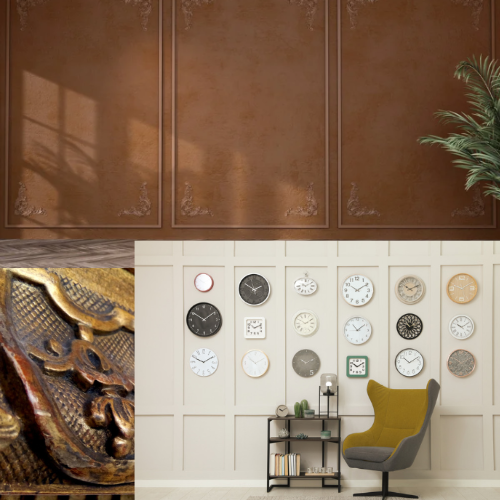
WPC stands for Wood Plastic Composite. It combines wood-based material with polymers and additives to create manufactured decorative products.
WPC mouldings and profiles are available in wood-like finishes, fluted patterns, linear designs and decorative wall trims.
They are particularly useful in modern interiors where homeowners want the appearance of wood-inspired detailing without using solid timber for every decorative element.
Some products are designed for relatively moisture-prone interior applications, but this does not mean every WPC profile is waterproof or suitable for direct water exposure.
Check the manufacturer’s technical specifications for moisture resistance, dimensional stability, fire performance and installation method.
WPC profiles can be used in living rooms, bedrooms, selected ceiling applications and decorative feature walls.
7. Wooden Mouldings: Natural and Premium Appearance
Wooden mouldings provide a natural appearance and are particularly suitable for traditional, contemporary-classical and premium interiors.
They are available in different timber species, profiles and finishes. Homeowners can select simple linear wooden borders or highly detailed carved profiles.
Common applications include:
Door and window architraves.
Decorative wall frames.
Furniture borders.
Wooden ceiling trims.
Wall panel detailing.
Decorative columns and pilasters.
Solid wood offers a natural grain pattern, but it requires suitable seasoning, moisture control and protection against termites and other biological damage.
Engineered wood-based decorative profiles may provide alternative options, depending on the intended application and environmental conditions.
For premium results, check the timber species, moisture content, joinery quality, finish and protective treatment.
8. Polystyrene Mouldings: Lightweight and Economical
Polystyrene mouldings are lightweight decorative profiles made from expanded or extruded polystyrene, depending on the product.
They are often used for simple ceiling cornices, wall borders and decorative frames.
Their relatively low weight makes handling and installation easier in suitable applications.
However, quality varies considerably. Some low-density products can dent easily, have uneven surfaces or show visible joints after installation.
Polystyrene is also combustible unless a suitable fire-rated formulation and tested assembly are specified. It should not be selected near heat sources or in fire-sensitive applications without checking its fire-performance documentation.
9. GRG Mouldings: Detailed Architectural Decoration
GRG stands for Glass Fibre Reinforced Gypsum. It is a manufactured gypsum-based material reinforced with glass fibres.
It is widely used in architectural applications requiring complex shapes, smooth surfaces and detailed decorative elements.
GRG can be used for:
Decorative ceiling panels.
Curved ceiling profiles.
Ornamental cornices.
Decorative columns.
Feature wall elements.
Custom architectural shapes.
It is particularly useful in projects where standard ready-made mouldings cannot achieve the desired architectural design.
However, GRG products require proper detailing, support, installation and joint treatment. They should not be confused with ordinary lightweight foam mouldings.
10. Decorative Columns, Pilasters and Arch Mouldings
For homeowners who want a grand architectural appearance, decorative columns, pilasters and arch mouldings can create a distinctive interior.
A pilaster is a shallow architectural element attached to a wall, generally designed to resemble a column. Decorative arches are used around entrances, passageways and selected wall openings.
These elements are commonly available in POP, PU, GRG, wood and other suitable materials.
They can be used in entrance foyers, living rooms, dining areas and feature walls.
However, decorative columns should not be mistaken for structural columns. They are generally aesthetic elements unless specifically engineered as structural components.
2. Decorative Moulding Prices in India: Material-Wise Cost Guide
One of the biggest questions homeowners ask is how much decorative moulding costs.
The price depends on the material, profile size, thickness, density, design complexity, manufacturing process, surface finish, brand and quantity.
Some suppliers charge per running foot, while others quote per piece, square foot, panel or complete installation.
The following figures are indicative planning ranges for the Indian market, not verified quotations from a particular manufacturer. Actual prices should be confirmed locally before purchasing.
Material / product | Indicative market price | Suitable applications |
|---|---|---|
POP wall moulding | ₹10–₹170 per running ft or piece, depending on listing and unit | Wall frames, ceiling borders |
PVC moulding | ₹12–₹230 per ft or piece, depending on profile | Wall trims, decorative borders |
EPS cornice | Around ₹138 per 2.4 m piece in one listed product | Ceiling borders |
PU decorative mouldings | Quotation-based; varies by profile and density | Ornamental walls, ceiling details |
WPC decorative profiles | Depends on thickness, finish and profile | Fluted walls, modern interiors |
Wooden mouldings | Depends on timber species and carving | Premium wall and door detailing |
GRC mouldings | Approximately ₹320–₹750 per sq. ft. in listed supplier offers | Large decorative architectural elements |
Conclusion
Decorative mouldings are an excellent way to give ordinary walls, ceilings, entrances and furniture a distinctive architectural appearance. From simple POP and PVC profiles to premium PU, WPC, wooden and GRG designs, homeowners have many options depending on their budget, design preferences and functional requirements.
One of the biggest advantages of modern decorative mouldings is the availability of ready-made as well as customised designs. You can purchase standard profiles from local interior material shops, manufacturers and online supplier platforms. If you want something unique, you can share your reference image or drawing with a manufacturer and request a customised profile.
Before purchasing, compare material quality, dimensions, surface finish, installation requirements and complete project costs. Also remember that the best design is not necessarily the most expensive one.
A carefully selected moulding design, installed with proper measurements and finishing, can make even a simple home look elegant, premium and visually unique.
Frequently Asked Questions
1. What are the best materials for decorative mouldings in homes?
PU, POP, PVC, WPC, wood, EPS and GRG are commonly used materials. PU is suitable for detailed lightweight decorative profiles, POP offers flexibility for traditional designs, PVC is useful for selected economical applications, while wood and GRG are suitable for different premium architectural requirements. The best material depends on location, moisture exposure, design and budget.
2. What is the price of decorative wall mouldings in India?
Decorative wall moulding prices vary according to material, size, thickness, design and manufacturer. Some basic POP and PVC profiles are available at relatively low prices, while premium PU, wooden and GRG elements can cost considerably more. Always compare quotations using the same dimensions and pricing units.
3. Where can I buy ready-made decorative mouldings in India?
You can purchase decorative mouldings from local POP and interior decoration shops, plywood and hardware dealers, architectural moulding manufacturers and online B2B platforms such as IndiaMART. Compare physical samples, specifications, delivery charges and installation support before ordering.
4. Can I get customised decorative mouldings according to my own design?
Yes. Many specialised manufacturers can develop customised mouldings using reference photographs, sketches, CAD drawings or 3D designs. Depending on the material and complexity, manufacturing may involve casting, custom mould creation or CNC machining. Request a sample or prototype before approving bulk production.
5. Which is better for wall mouldings: PU or POP?
PU is generally preferred when lightweight, factory-made profiles with detailed designs are required. POP is useful for traditional decorative designs and site-created profiles where skilled craftsmen are available. PU and POP have different installation, moisture and repair characteristics, so the selection should depend on the application.
6. Are decorative mouldings suitable for small bedrooms?
Yes. Small bedrooms can look attractive with slim rectangular wall mouldings or simple geometric profiles. Avoid oversized ornamental designs and excessive wall divisions. A few carefully positioned frames behind the bed can create an elegant appearance without making the room feel crowded.
7. Can decorative mouldings be painted in different colours?
Yes, many POP, PU and specially designed PVC profiles are paintable. However, the required primer and paint system depend on the material. Some products also come with factory-applied decorative finishes. Always confirm paint compatibility with the manufacturer.
8. How long do decorative mouldings last?
Their lifespan depends on material quality, installation, environmental conditions and maintenance. Properly installed and maintained mouldings can remain attractive for many years. However, moisture, poor adhesives, physical damage and unsuitable installation can reduce their service life.
9. Can decorative mouldings be installed on existing walls?
Yes. Most lightweight decorative profiles can be installed on existing walls if the surface is stable, clean and properly prepared. Before installation, repair cracks, loose plaster and dampness. Heavy decorative elements may require additional mechanical support depending on their weight and substrate.
10. Can decorative mouldings be used with false ceilings and LED lighting?
Yes. Decorative cornices and specially designed ceiling profiles can be combined with false ceilings and concealed LED lighting. However, the lighting channel, electrical wiring, driver accessibility, heat management and fixing arrangements should be planned before installation.