

Basement Waterproofing Guide for Lucknow Buildings
A basement adds tremendous value to a residential or commercial building. It provides additional parking, storage space, utility rooms, and even recreational areas. However, because a basement is constructed below ground level, it is constantly exposed to groundwater pressure, soil moisture, and seasonal rainfall. Without proper waterproofing, even a newly built basement can develop seepage, damp walls, mold growth, peeling paint, and structural deterioration within a few years.
In a city like Lucknow, where the monsoon season brings heavy rainfall and groundwater levels vary across different localities, basement waterproofing becomes one of the most critical aspects of construction. Many property owners invest heavily in architectural design and interiors but underestimate the importance of waterproofing. Unfortunately, repairing a leaking basement after construction is far more expensive than installing a reliable waterproofing system during construction.
At Kanakdhara Developer Private Limited, we believe that basement waterproofing should never be treated as an optional upgrade. It is a long-term investment that protects the structure, improves indoor air quality, and significantly reduces maintenance costs. This comprehensive guide explains everything homeowners and developers should know before constructing a basement in Lucknow.
Why Basement Waterproofing Is Essential
Unlike upper floors, basement walls remain in continuous contact with soil that retains moisture throughout the year. During the rainy season, hydrostatic pressure builds around the foundation walls and pushes water toward the building. Even tiny cracks in concrete or construction joints become entry points for moisture.
Over time, water infiltration can cause damp walls, corrosion of reinforcement steel, concrete deterioration, mold growth, unpleasant odors, damaged electrical installations, and weakened structural elements. Waterproofing acts as a protective barrier that prevents groundwater from entering the basement while extending the life of the entire building.
Basement Waterproofing Challenges in Lucknow
Lucknow’s climate presents unique challenges for underground construction. Heavy monsoon rainfall, clay-rich soil in several areas, and fluctuating groundwater levels increase the possibility of water seepage around basement walls.
In many residential developments, inadequate site drainage further compounds the problem by allowing rainwater to accumulate around the building foundation. Older neighborhoods may also experience poor stormwater drainage, increasing the hydrostatic pressure on basement structures during prolonged rainfall.
For these reasons, basement waterproofing in Lucknow should always be planned according to local soil conditions rather than using a standard solution for every project.
Types of Basement Waterproofing Systems
A successful waterproofing system combines multiple protective layers rather than relying on a single product.
External Waterproofing
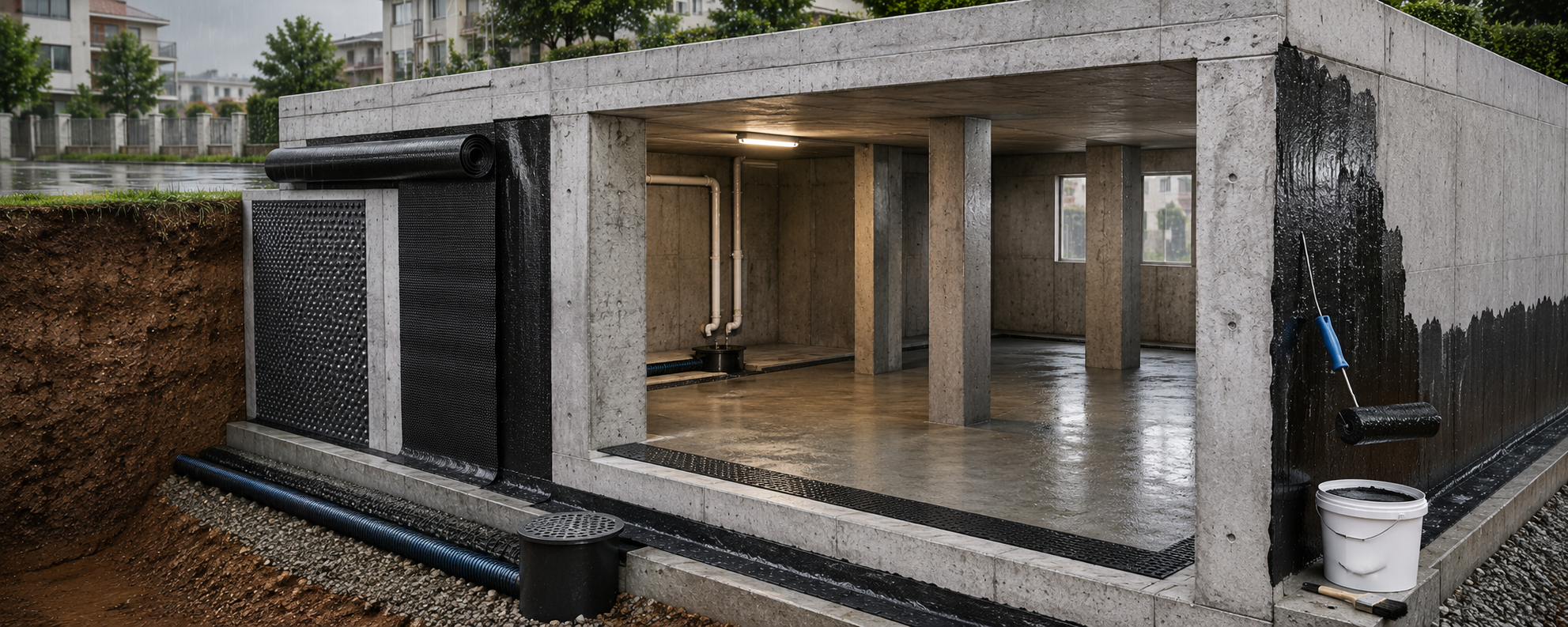
External waterproofing is considered the most effective solution because it prevents water from reaching the basement wall. Before backfilling the excavation, waterproof membranes, protective boards, drainage layers, and waterproof coatings are installed on the outer surface of basement walls.
This approach blocks groundwater before it enters the concrete, providing long-term structural protection.
Internal Waterproofing
Internal waterproofing manages moisture that has already entered the structure. Waterproof coatings, crystalline treatments, injection grouting, and drainage channels help control water movement inside the basement.
Although internal waterproofing is useful for repairs, it should not replace proper external waterproofing during new construction.
Integral Waterproofing
Integral waterproofing involves mixing specialized waterproofing admixtures directly into the concrete. These additives reduce concrete permeability, making the structural elements more resistant to water penetration.
When combined with external membranes, integral waterproofing provides an additional level of protection.
Key Areas That Need Waterproofing
Many basement leaks occur because only the walls are waterproofed while other vulnerable locations are ignored.
The basement floor slab should receive proper waterproof treatment to resist upward groundwater pressure. Construction joints between slabs and walls require water bars or sealing systems because these joints are common leakage points.
Expansion joints, pipe penetrations, lift pits, retaining walls, and service openings also require specialized waterproof detailing to prevent future seepage.
Importance of Proper Drainage
Waterproofing alone cannot solve every moisture problem. A well-designed drainage system is equally important.
Perimeter drains installed around basement walls collect groundwater and direct it away from the structure. Proper surface grading ensures rainwater flows away from the building instead of collecting near foundation walls.
In locations where groundwater remains consistently high, sump pits and automatic dewatering pumps provide additional protection during heavy rainfall.
Choosing the Right Waterproofing Material
Modern construction offers several waterproofing products, each designed for different site conditions. Bituminous membranes provide excellent external protection, while liquid-applied membranes create seamless waterproof layers over concrete surfaces.
Crystalline waterproofing systems penetrate the concrete and block microscopic water pathways. Polyurethane coatings offer flexibility for areas subject to movement, while cementitious coatings are widely used for internal waterproofing applications.
Selecting the right system requires professional evaluation of groundwater conditions, structural design, and intended basement usage.
Common Waterproofing Mistakes
One of the biggest mistakes is beginning waterproofing only after water leakage appears. By that stage, repairing damage often involves excavation, concrete repairs, and expensive restoration work.
Another common error is using low-quality waterproofing materials to reduce construction costs. Inferior products may fail within a few years, requiring complete replacement.
Poor workmanship is another major cause of leakage. Even premium waterproofing products cannot perform effectively if joints, corners, and pipe penetrations are not treated correctly.
Ignoring curing time, failing to protect waterproof membranes during backfilling, and inadequate quality inspections also reduce waterproofing performance.
A Unique Perspective: Waterproofing Is an Investment, Not an Expense
Many homeowners compare waterproofing costs with visible upgrades such as flooring, modular kitchens, or decorative lighting. While these finishes improve appearance, they can be replaced relatively easily. Basement waterproofing, however, protects the very structure that supports your investment.
Think of waterproofing as an insurance policy for your building. Spending a small percentage of your construction budget on a professionally designed waterproofing system can prevent years of recurring repairs, repainting, mold removal, damaged furniture, and structural rehabilitation. The return on investment becomes even greater for commercial buildings where moisture damage can interrupt business operations.
Why Choose Kanakdhara Developer Private Limited?
At Kanakdhara Developer Private Limited, we understand that durable construction begins below ground level. Our experienced architects, structural engineers, and construction professionals design basement waterproofing systems that are tailored specifically to Lucknow’s soil conditions and climate.
From soil investigation and structural planning to foundation waterproofing, retaining wall protection, drainage design, and quality inspections, every stage is executed using proven engineering practices and premium waterproofing materials. We carefully inspect construction joints, service penetrations, and membrane installations to ensure long-lasting protection against seepage and groundwater pressure.
Our integrated approach combines architectural planning, structural engineering, BOQ preparation, quality-controlled construction, and professional project management, giving homeowners complete confidence that their basement will remain dry, durable, and maintenance-friendly for years to come.
Conclusion
A basement is one of the most valuable spaces in any building, but only when it remains dry and structurally sound. Proper waterproofing protects your investment from groundwater, dampness, mold, corrosion, and expensive future repairs. In Lucknow’s climate, where seasonal rainfall and varying groundwater levels create additional challenges, professional waterproofing is essential rather than optional.
Whether you are planning a new home, a commercial complex, or renovating an existing basement, choosing the right waterproofing system from the beginning can save substantial time and money over the building’s lifetime.
If you are planning basement construction in Lucknow, Kanakdhara Developer Private Limited offers complete architectural design, structural engineering, basement waterproofing solutions, RCC construction, and end-to-end project management. Our commitment to quality, transparency, and engineering excellence ensures every building is protected from the ground up.